


Newborn Bedtime Routine: A Pediatrician's Step-by-Step Guide (0–3 Months)


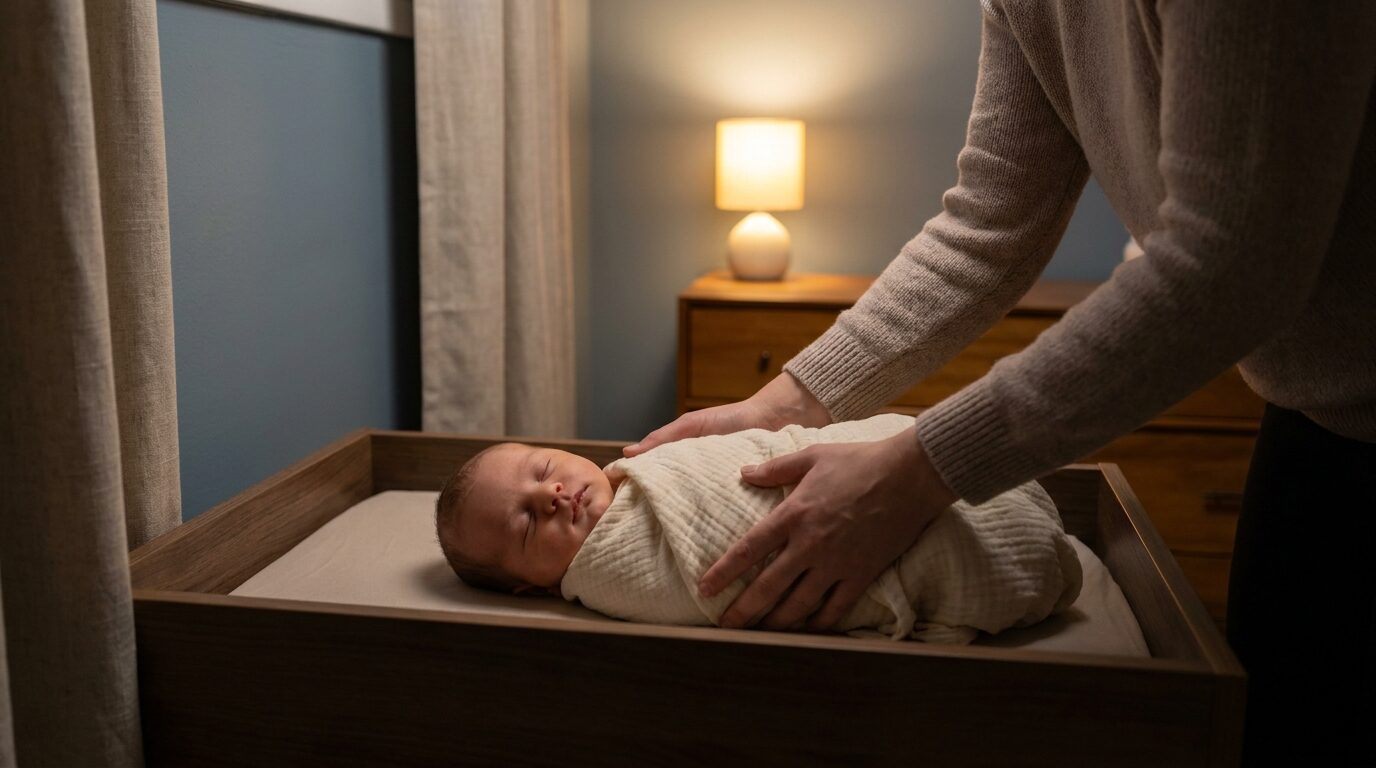
A newborn bedtime routine (also called an infant bedtime routine) is a short, calming sequence you repeat in the same order each night. The four core steps: feed, bath or warm wipe-down, quiet dim-light time, then swaddle and back-to-sleep. For babies 0–3 months, the routine works best as gentle consistency, not strict clock times. Its job is to cue your baby's brain that sleep is next.
In Blueberry telehealth visits, a common newborn-sleep question is whether it's "too early" to start a routine. The reassuring answer: it isn't.
Key Takeaways
- You can start a gentle bedtime routine as early as 6–8 weeks of age.
- Four calm steps work well: feed, bath or warm wipe-down, quiet time, and sleep.
- Aim for 20–40 minutes from start to finish.
- Newborns under 3 months do not sleep through the night — that is normal.
- Watch your baby's sleep cues, not the clock.
- Always place your baby on their back, on a firm, flat, non-inclined surface.
- Keep the crib clear: no blankets, pillows, bumpers, or weighted products.
When Should You Start a Bedtime Routine With a Newborn?
You can start as early as 6–8 weeks. Clearer benefits usually show up around 8–12 weeks, once your baby's body clock begins to mature.
Most families can begin a gentle bedtime routine between 6 and 8 weeks of age. Give the routine two to four weeks before you see smoother settling. Starting earlier is fine and causes no harm. The bigger shift tends to happen between 8 and 12 weeks. That's when your baby's circadian rhythm and melatonin production start to come online.
What Should a Newborn Bedtime Routine Include?
A simple four-step sequence works for 0–3 months. The order: feed, bath or warm wipe-down, quiet dim-light time, then swaddle and back-to-sleep.
Keep the sequence simple and the order the same every night. Your baby's brain pattern-matches the steps, not the clock. Start with a calm feed, then a bath or gentle wipe-down. Add five to ten minutes of dim-light quiet. Finish with a hip-healthy swaddle and back-sleep placement.
1. Feeding
A full feed is a normal first step. In the 0–3-month window, feeding to sleep is developmentally appropriate, not a bad habit. Hold your baby upright for 10–20 minutes after the feed to reduce spit-up. Then lay your baby down on their back. Do not prop bottles or put a bottle in the crib.
2. Bath or Gentle Wipe-Down
Full baths only need to happen two to three nights a week. Before your baby’s umbilical cord stump falls off (usually 1–3 weeks), use sponge bathing instead of a tub bath. See our guide on newborn bath frequency. On non-bath nights, use a warm-washcloth wipe-down at the same spot in the routine. Keep water body-temperature-warm, around 90–100°F. Test with your wrist. Never leave your baby alone in the bath, even for a second.
3. Quiet, Dim-Light Time
Dim the lights. Turn off screens. Use a soft, low voice. Pick one or two calming activities: gentle massage, soft singing, skin-to-skin, or a short story. Five to ten minutes is plenty. This step trains your baby's brain to link dim plus quiet plus calm with "sleep is next."
4. Swaddle and Place in Crib/Bassinet
Use a hip-healthy swaddle — hips and knees flex, legs bend up and out. Place your baby on their back on a firm, flat, non-inclined surface. Use their own crib or bassinet, placed in your room for at least the first 6 months (see newborn safe sleep position). The sleep space stays clear: no blankets, pillows, bumpers, stuffed animals, sleep positioners, or weighted products. A pacifier at sleep onset is fine once breastfeeding is well established, usually around 3–4 weeks. Don’t reinsert it once your baby is asleep, and never attach clips, strings, or tethers during sleep. Stop swaddling at the first sign of rolling.
How Long Should a Newborn Bedtime Routine Take?
Aim for 20–40 minutes, start to finish. Very sleepy newborns may only need 15–20 minutes. Longer than 45 minutes often overstimulates.
The sweet spot for most 0–3-month-olds is 20–40 minutes. Shorter is fine for very young or very sleepy newborns. Longer than 45 minutes tends to overstimulate and leave your baby overtired. What matters most is the same order each night. Same steps, same sequence — that's what your baby's brain learns to recognize.
How to Recognize Newborn Sleep Cues
Early cues mean your baby is ready for sleep. Watch for quieting, a glazed stare, slow movement, and hands to face. Yawning is a late sign.
Watch your baby, not the clock. Early cues are subtle and easy to miss. If you wait for eye rubbing, arching, or hard crying, your baby is already overtired. Overtired babies are much harder to settle. Most newborns comfortably stay awake only 45–90 minutes between sleeps.
Early cues (start the routine now):
- Slowing movement
- Quieting, with a glazed or far-away stare
- Hands going to the face
- Soft fussing that settles with interaction
Late cues (already overtired — comfort, then shorten the next wake window):
- Yawning and eye rubbing
- Ear pulling or arching
- Hard-to-soothe crying
- Rapid breathing and flailing limbs
Common Mistakes Parents Make with Newborn Bedtime Routines
The most common mistakes: expecting newborns to sleep through the night and waiting for yawning.
Most bedtime struggles come from expectations, not the routine itself. A 6-week-old will not sleep eight hours straight. Yawning is already a late cue. Adjust expectations first, and the routine tends to feel less like it's failing.
- Myth: "My baby should sleep through the night by 3 months." Reality: Most 3-month-olds still wake one to three times overnight for feeds.
- Myth: "Feeding to sleep is a bad habit." Reality: In the 0–3-month window, feeding to sleep is developmentally appropriate.
- Myth: "Weighted swaddles help babies sleep safely." Reality: Weighted swaddles, sleep sacks, and blankets are not safe for infants.
- Myth: "Give melatonin if my baby won't settle." Reality: Melatonin is not recommended under age 3. Never give it to an infant.
- Myth: "Crib bumpers and inclined sleepers are fine." Reality: Both are banned under the Safe Sleep for Babies Act of 2021.
- Myth: "Louder white noise equals deeper sleep." Reality: Keep the machine at least 7 feet from the crib. Cap volume at 50 dB. Turn it off or down once your baby is asleep.
Realistic Sleep Expectations for Newborns (0–3 Months)
Newborns sleep 14–17 hours across 24 hours in short cycles. The first 4–6-hour stretch usually emerges around 6–12 weeks.
Fragmented sleep is biology, not failure. About half of newborn sleep is active (REM), so your baby stirs and squirms without fully waking. Day-night rhythm is built, not born — bright daylight by day and dim light at night help it settle in. See our guide to baby sleep cycles for more.
A pattern from Blueberry pediatrician visits: families who keep the same four steps in the same order settle faster. If you're unsure what you're seeing, talk to a Blueberry pediatrician 24/7 about your newborn's sleep.
When to Call Your Pediatrician About Sleep Concerns
Call 911 for fever under 3 months, breathing pauses over 20 seconds, blue lips, or unresponsiveness. Call your pediatrician for poor feeding.
Most newborn sleep patterns are normal, even when they feel hard. Some signs need urgent care. Use the tiers below to self-triage. When in doubt, call.
Call 911 or go to the ER right now if:
- Your baby has any fever of 100.4°F (38.0°C) or higher. Any fever under 3 months is a medical emergency.
- Your baby has breathing pauses longer than 20 seconds, bluish lips, or limpness.
- Your baby is unresponsive, having a seizure, or cannot be awakened.
- Breathing is labored, sustained over 60 breaths per minute at rest, or shows deep chest retractions or grunting.
Call your pediatrician the same day if:
- Your baby is hard to rouse for feeds or sleeping much more than usual.
- Your baby has fewer than 4–6 wet diapers per day after day 4–5 of life.
- Your baby has not regained birth weight by 14 days, or gains less than 4–6 ounces per week.
- Feeding is becoming harder, with choking, coughing, or color change.
- You hear persistent loud or high-pitched breathing (stridor), even when calm.
Schedule a routine visit if:
- You've kept a consistent routine for 2–3 weeks and your baby seems chronically overtired.
- You aren't sure whether what you're seeing is normal.
FAQ: Newborn Bedtime Routine Questions Parents Ask
At what age can I start a bedtime routine with my newborn?
You can start as early as 6–8 weeks. Clearer benefits usually show around 8–12 weeks, as your baby's circadian rhythm matures. Keep it gentle. Give it 2–4 weeks before expecting smoother settling.
What should a newborn bedtime routine include?
Four steps: a calm feed, a bath or warm wipe-down, and 5–10 minutes of quiet dim-light time. Finish with a hip-healthy swaddle and back-sleep placement. Consistency of sequence matters more than any specific activity.
How long should a bedtime routine be for a newborn?
About 20–40 minutes works for most 0–3-month-olds; very sleepy newborns may need only 15–20. Cap at 40 to avoid overstimulation. Same steps, same order — that's what your baby learns.
Should I bathe my newborn every night as part of the routine?
No. The AAP recommends 2–3 baths per week in the first year. Use a warm-washcloth wipe-down on non-bath nights to keep the cue consistent.
What are newborn sleep cues?
Early cues are subtle. Watch for slowing movement, a glazed stare, hands to the face, or soft fussing that settles with interaction. Yawning and eye rubbing are late signs. Start the routine at the early cues so your baby falls asleep before becoming overtired.
Is a bedtime routine the same as a sleep schedule?
No. A routine is the same few calming steps in the same order each night. A schedule is a set of clock-based sleep and wake times. Newborns are not biologically ready for a true schedule. Routines come first; schedules usually emerge around 3–4 months.
Can a bedtime routine help my newborn sleep longer stretches?
Gradually, yes. Consistent routines shorten settling time in older infants; in newborns the effect is more modest but a predictable wind-down helps settling as the circadian rhythm matures.
When should I be concerned about my newborn's sleep?
Call your pediatrician the same day if your baby is hard to wake or isn't feeding well. Also call for fewer than 4–6 wet diapers a day or poor weight gain. Call 911 for any fever under 3 months, breathing pauses over 20 seconds, blue lips, or unresponsiveness.
Is it OK to nurse or bottle-feed my baby to sleep?
Yes. Per AAP's 0–3 month guidance, feeding to sleep is normal and not a bad habit in the first 3 months. Lay your baby down on their back once they are sleep-ready. Avoid propping bottles or leaving a bottle in the crib.
How do I know if my newborn is ready for sleep?
Watch your baby, not the clock. Early cues: quieting, a glazed stare, slower movement, or hands to face. Most newborns comfortably stay awake only 45–90 minutes between sleeps. If you wait for yawning or eye rubbing, your baby is already overtired.
This article is for general educational purposes and is not a substitute for personalized medical advice. If you have concerns about your newborn's sleep or health, talk to a Blueberry pediatrician 24/7.
Sources:
- Moon RY, Carlin RF, Hand I; AAP Task Force on SIDS. Sleep-Related Infant Deaths: Updated 2022 Recommendations for Reducing Infant Deaths in the Sleep Environment. Pediatrics. 2022;150(1):e2022057990.
- Pantell RH, Roberts KB, Adams WG, et al. Evaluation and Management of Well-Appearing Febrile Infants 8 to 60 Days Old. Pediatrics. 2021;148(2):e2021052228.
- Mindell JA, Telofski LS, Wiegand B, Kurtz ES. A nightly bedtime routine: impact on sleep in young children and maternal mood. Sleep. 2009;32(5):599–606.
- AAP Committee on Environmental Health. Preventing Excessive Noise Exposure in Infants, Children, and Adolescents. Pediatrics. 2023;152(5):e2023063752.
- International Hip Dysplasia Institute. Hip-Healthy Swaddling position statement.
- Consumer Product Safety Commission. Safe Sleep for Babies Act of 2021.
- HealthyChildren.org (AAP). "Bathing Your Baby," "Swaddling: Is it Safe for Your Baby?," "How to Keep Your Sleeping Baby Safe."
- Mayo Clinic. "Baby bath basics: A parent's guide."


.svg)





.svg)
.svg)

