


My Baby Fell Off The Bed: What To Do (Pediatrician)



Medically Reviewed by: Dr. Melissa Tribuzio, MD, Board-Certified Pediatrician
Last reviewed: April 2026
First: Take A Breath. Most Falls Are Okay.
Your baby fell off the bed and your heart is pounding. Take one breath. Most short falls — under 3 feet, onto carpet or another soft surface — do not cause serious harm. Comfort your baby. Check for the red flags below. Then watch them closely for the next 24 hours.
Calls about an infant fall from bed are one of the most common reasons parents reach our 24/7 telehealth — and the vast majority of these babies are absolutely fine. This guide walks you through what a pediatrician would: what to look for, when to call 911, when to call us, and when to watch and wait.
Key Takeaways
- Most short falls under 3 feet onto a soft surface do not cause a serious head injury.
- Pick your baby up and comfort them first. Crying right away is a reassuring sign.
- Call 911 for loss of consciousness, seizure, repeated vomiting, a baby who will not wake up, or any visible deformity.
- Babies under 3 months should be checked the same day, even if they seem fine.
- Watch for new warning signs for the first 24 hours, then more closely than usual for 48 hours total.
- It is safe to let your baby sleep after a fall, as long as none of the red flags below are present.
Step 1 — Comfort Your Baby First
Pick your baby up gently and hold them. Move slowly, in case there is a neck or spine injury. If they cry within a few seconds, that is a good sign. It tells you they are awake and breathing.
Sit on the floor with them. Keep them calm. Then move on to the red-flag check below.
If your baby is unresponsive, limp, or not breathing normally — call 911 first, then check for breathing and start CPR if you have been trained.
Step 2 — Check For Immediate Red Flags (Call 911)
If your baby has any of the signs below, call 911 or go to the nearest ER right now. The American Academy of Pediatrics (AAP) endorses the CDC Pediatric mTBI Guideline, which lists these signs as needing emergency care.
Loss of consciousness
Your baby passed out, even briefly. Any time without responsiveness counts.
Vomiting more than once
One spit-up after a hard cry can be normal. Two or more true vomits within a few hours is a warning sign of pressure inside the head.
Seizure
Stiffening, jerking, staring, or sudden loss of muscle tone after a fall is an emergency. Note how long it lasts.
Bleeding that won't stop
Apply firm pressure with a clean cloth. If bleeding does not slow within 10 minutes, head to the ER. Clear fluid leaking from the nose or ears is also a red flag — it can be cerebrospinal fluid (the fluid that cushions the brain).
Visible deformity
A dent, a soft swollen area on the side or back of the head, or anything that looks "off" about the skull shape needs evaluation right away.
Won't wake up or seems unresponsive
If you cannot rouse your baby, or they wake up but seem confused, drowsy, or not themselves — call 911. Bruising behind the ears (Battle's sign), bruising around the eyes (raccoon eyes), or a bulging soft spot are also signs of a possible skull fracture.
Not sure if it's an emergency? Talk to a Blueberry pediatrician 24/7 — most baby-fall calls take five minutes to settle.
Step 3 — Watch For 24-Hour Warning Signs
Even after a calm first hour, keep an eye out for the next full day. The first 24 hours catch most delayed problems. The next 24 hours catch the rest. Call your pediatrician if you see any of these.
Persistent fussiness or unusual sleepiness
Way more crying than usual, or way more drowsy than usual, after the first hour. This is different from the post-cry exhaustion right after the fall.
Repeated vomiting (different from spit-up)
More than one true vomit, especially if it happens hours after the fall.
Unequal pupils
Look at the black centers of your baby's eyes in even light. If one is bigger than the other, call us right away.
Bulging soft spot (in babies under 18 months)
The soft spot on top of the head should feel flat or slightly soft when your baby is calm and sitting up. A tense, bulging soft spot can mean pressure inside the skull.
Loss of balance or weakness on one side
Older infants who were already crawling, sitting, or walking may stumble, drop a toy, or stop using one arm. Any new clumsiness or one-sided weakness is a warning sign.
When To Call Your Pediatrician (vs. ER vs. Wait-And-Watch)
Call 911 for any red flag in Step 2; call your pediatrician for under-3-month babies, large bumps, or any uncertainty; otherwise watch at home for 24 hours.
Pediatricians use the PECARN rule (Pediatric Emergency Care Applied Research Network) when examining a child to help decide if imaging is needed. A 2024 validation study in the Lancet Child & Adolescent Health of nearly 20,000 children confirmed it remains the gold standard for that imaging decision. The list below is a separate, parent-friendly tool — use it to decide whether to head to the ER, call your pediatrician, or watch at home.
Go to the ER now if any of these apply:
- Loss of consciousness, seizure, more than one vomit, or unresponsiveness.
- A fall higher than 3 feet — about the height of a kitchen counter or changing table — onto a hard surface.
- Bulging soft spot, visible deformity, or clear fluid from the nose or ears.
- Any squishy or noticeably large (about 2 inches / 5 cm or bigger) bump on the side or back of the head, in a baby under 1 year.
Call your pediatrician today (or use Blueberry 24/7 telehealth) if:
- Your baby is under 3 months old, even if they seem fine. Their skulls are very thin and their behavior is hard to read.
- There is a bump on the side or back of the head bigger than 5 cm (about 2 inches) in a baby 1 year or older, with no other symptoms.
- Your baby vomited once and has no other symptoms — but you want a second opinion.
- You are not sure how high the fall was, or it landed on a hard floor.
It is safe to watch at home if all of these are true:
- Your baby is older than 3 months.
- They are alert and acting normally — feeding, smiling, focusing on faces.
- There was no loss of consciousness.
- There is no bump on the side or back of the head — only on the forehead, if anywhere.
- There is no dent or step-off you can feel on the skull.
- The fall was less than 3 feet (about the height of a standard bed or sofa).
When all of these are true, the chance of a serious traumatic brain injury is essentially zero.
In the gray zone? Talk to a Blueberry pediatrician 24/7 — that is exactly what telehealth is for.
Should I Let My Baby Sleep After Falling?
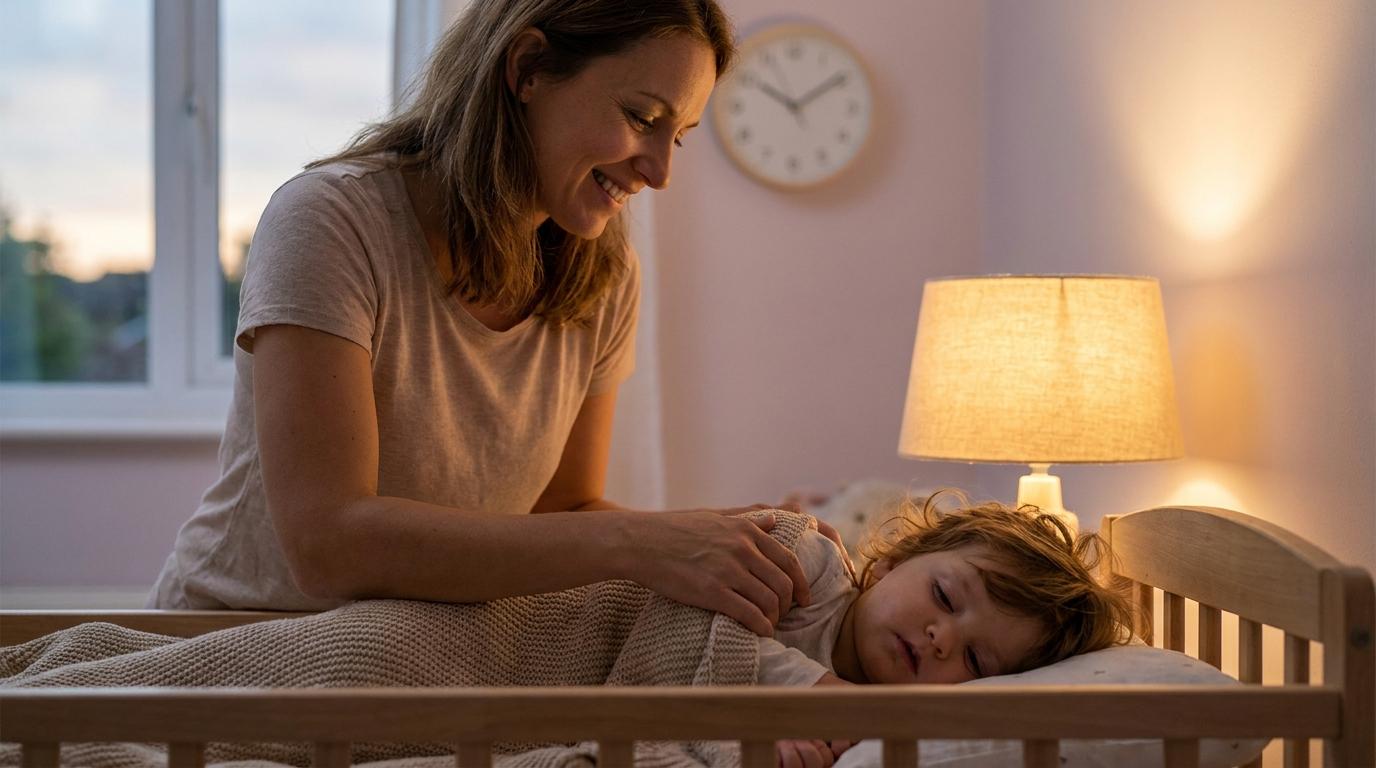
Yes — let your baby sleep after a fall as long as none of the red flags above are present; rest helps the brain recover after a minor head bump. Consider sleeping in the same room for the first night.
The old advice to wake your baby every 1 to 2 hours is now considered an outdated myth. The Cleveland Clinic, Seattle Children's Hospital, and pediatric neurosurgeons agree: rest helps the brain recover.
What to do instead:
- Sleep in the same room as your baby for the first night.
- Watch for normal, regular breathing.
- If breathing looks irregular, or you cannot wake your baby at the next normal feed or in the morning — call 911.
You don't need to set an alarm and wake them up. You do need to be close enough to notice if something is wrong. For general baby sleep-position safety, see Can Newborns Sleep On Their Side.
How Worried Should I Be About A Baby Falling Off The Bed?
Less worried than you feel — fewer than 1 in 100 babies who fall from low heights have a serious brain injury that needs treatment.
Here are the numbers from decades of pediatric research:
- About 1 to 3 in 100 may get a simple skull crack — a thin line in the bone — with no brain damage and no surgery needed.
- Bleeding inside the skull from a fall this short is extremely rare — well under 1% of cases.
Why parents still feel scared: babies look small, beds feel high. But the soft floor, short distance, and a baby's first instinct to cry usually protect them.
A safety note: Doctors are trained to ask careful questions when a child has a serious head injury. This is routine — not about you personally.
Preventing Falls In The Future
Most baby falls happen on beds, sofas, and changing tables — keeping a hand on baby and using safety straps prevents the vast majority.
- Never leave your baby alone on a bed, sofa, or changing table — not even for a second to grab a wipe.
- Keep one hand on your baby on any surface above the floor.
- Use a changing pad with raised sides and the safety strap.
- Move your baby to the floor — onto a play mat — the moment you need both hands.
- Once your baby can roll (around 4 months), do diaper changes on the floor as a default.
- Lower the crib mattress at appropriate times based on the manufacturer's instructions.
- Install safety gates at the top and bottom of stairs before your baby is mobile.
Frequently Asked Questions
How long should I watch my baby after a fall?
For 24 hours after the fall, check on them every couple of hours while they are awake, and once or twice while they sleep. After that, keep a closer-than-usual eye on them through 48 hours total. Most warning signs show up in the first day.
How do I know if my baby has a concussion (a brain injury from a bump or jolt)?
In babies, doctors use the term "mild traumatic brain injury" instead of "concussion," because babies cannot tell you their head hurts. Watch for changes that don't make sense. Examples: a baby who suddenly stops eating, sleeps much more than usual, stares blankly, or becomes very fussy without another reason. Any of those after a fall is worth a call to your pediatrician.
My baby fell on their head — what should I look for?
Run through the six red flags in Step 2 first. Then check the spot of the bump. A bump on the forehead is common and usually fine. A bump on the side or back of the head, especially in a baby under 1 year, is more concerning and worth a phone call.
Can a baby be okay after falling off the bed?
Yes — and most are. Studies of hundreds of infants who fell from beds and changing tables found very few serious injuries. If your baby cried right away, is acting normally now, and has none of the red flags above, the chance of real harm is very low.
Is it bad if my baby cries for a long time after a fall?
A few minutes of crying is normal — they were scared and probably hurt where they landed. If your baby is still crying in a way you cannot soothe after one hour, or the cry sounds different than usual, call your pediatrician.
When should I take my baby to the ER vs. call my pediatrician?
Go to the ER for any red flag in Step 2. That includes loss of consciousness, seizure, repeated vomiting, deformity, a baby who won't wake up, or a fall over 3 feet onto a hard surface. Call your pediatrician (or use 24/7 telehealth) for everything else that worries you, including any baby under 3 months who has fallen.
Still not sure? Talk to a Blueberry pediatrician 24/7. Most baby-fall calls take five minutes to settle — and the peace of mind is worth it.
About This Article
Medically reviewed by: Dr. Melissa Tribuzio, MD, Board-Certified Pediatrician
Last reviewed: April 2026
Sources: American Academy of Pediatrics (HealthyChildren.org); CDC Pediatric mTBI Guideline; PECARN Decision Rule (Kuppermann 2009); Holmes 2024 Lancet Child & Adolescent Health validation; NICE Head Injury Guideline NG232; Cleveland Clinic concussion guidance; Seattle Children's concussion page.
Disclaimer: This article is for educational purposes and is not a substitute for medical care. If you are worried about your baby's head injury, call your pediatrician or 911. Blueberry Pediatrics offers 24/7 telehealth for parents of children 0–18.


.svg)





.svg)
.svg)

