


Newborn Sleeping on Chest: Is It Safe? AAP Guidance


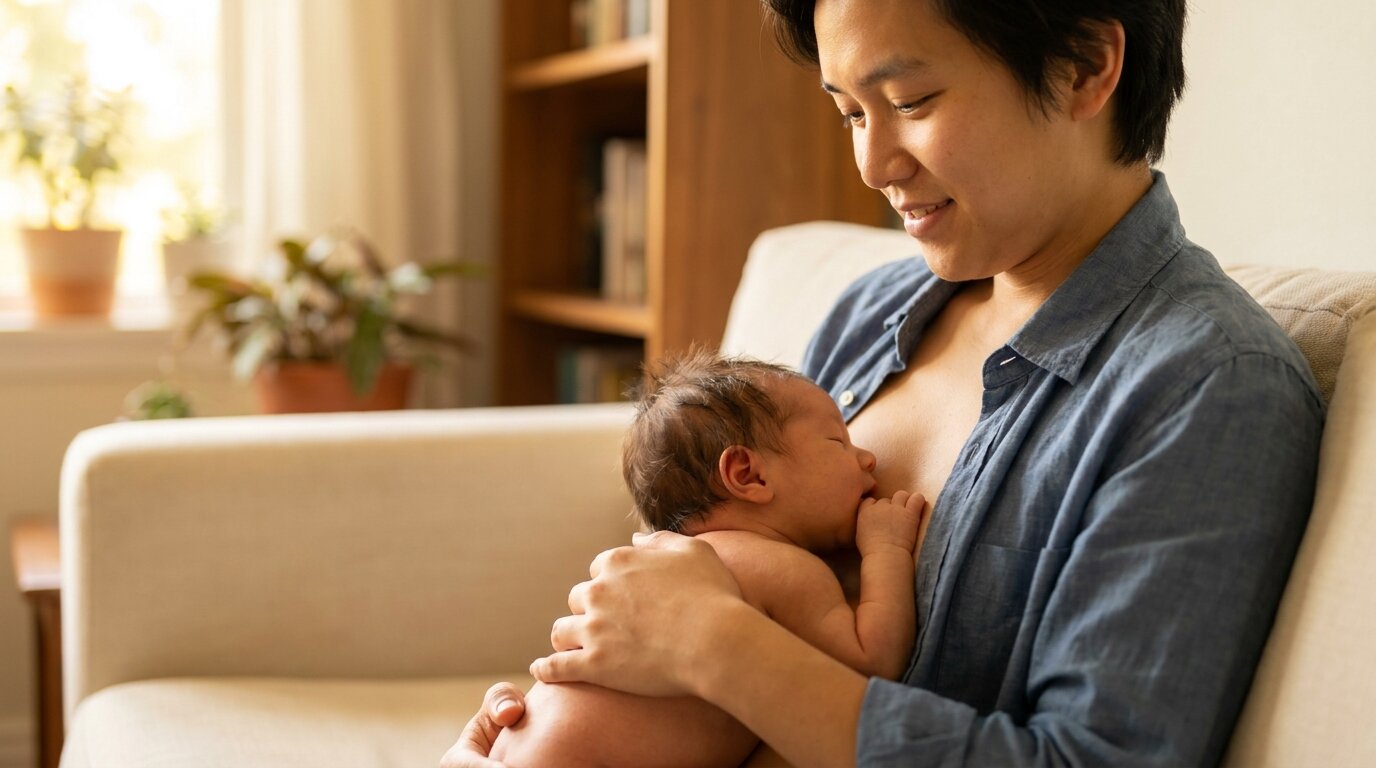
Is It Safe for a Newborn to Sleep on Your Chest?
A newborn sleeping on your chest is safe only when you are fully awake and alert. Holding your baby skin-to-skin while you watch them is one of the most beneficial things you can do in the first weeks of life. The danger is falling asleep with your baby on you. According to the American Academy of Pediatrics (AAP), this is one of the most common causes of accidental infant suffocation. The safest sleep place for any sleep your baby gets, including a quick nap, is their own crib or bassinet, on a flat firm surface, on their back.
Key Takeaways
- Awake and alert holding is safe and good for your baby. Asleep holding is not.
- AAP safe sleep is four words: back, alone, flat, firm. Every nap and every night.
- The risk of sleep-related infant death is 49 to 67 times higher on a sofa, armchair, or recliner than in a crib. These are the most dangerous places to fall asleep with a baby.
- "Only sleeps on my chest" is almost always a sleep preference, not a medical problem. A small group of babies have reflux or another airway issue worth checking with your pediatrician.
- If you wake up and realize you fell asleep with your baby on you, place them on their back in a crib or bassinet and check that they are breathing normally. No shame, no panic. Plan for next time.
- Wedges, inclined sleepers, and propped mattresses are not safe and do not help reflux.
- About 3,700 babies die each year in the United States from sleep-related causes (CDC 2022, with rates rising since 2020). Most of these deaths happen in a sleep environment that was not flat, firm, and clear of other people.
The Bright Line: Awake Is Safe, Asleep Is Not
The question "is a newborn sleeping on chest safe?" has a precise answer, and every major safe-sleep authority in the developed world (the AAP, the National Institute of Child Health and Human Development, the Centers for Disease Control and Prevention, and the United Kingdom's Lullaby Trust) gives parents the same answer about chest sleeping. The line is wakefulness, not minutes on a clock.
When you are awake and alert, your baby on your bare chest is called skin-to-skin contact, or kangaroo care. The 2025 research review concludes that immediate skin-to-skin contact at birth should be the global standard of care, with benefits for breastfeeding initiation and physiologic stability.
When you fall asleep with your baby on you, the math changes completely. Your baby cannot move their head, lift their chin, or call for help if their airway is blocked. You cannot watch them. That is the moment a safe hold turns into an unsafe sleep environment.
The honest version, the one we tell parents in clinic: as long as you might fall asleep, even mid-feed, your baby goes back to the crib first.
Why a Newborn Sleeping on Chest Feels So Natural
Newborns are wired for closeness. Your warmth, your heartbeat, your smell, and the gentle rise and fall of your breathing all remind your baby of the womb. Babies who lie on a caregiver's chest while awake tend to have steadier heart rates, more stable breathing, and an easier time learning to feed.
This is biology, not a bad habit. You did not create the preference, and you cannot "spoil" a newborn by holding them.
So what is the goal? Keep the closeness. Change where the sleeping happens.
That looks like:
- Lots of awake, supervised chest time during the day. Hold, snuggle, do skin-to-skin.
- Move your baby to a flat, firm crib or bassinet for any sleep, including short naps.
- Use cues from your baby's environment (swaddle, white noise, a slightly dim room, a consistent feed-and-place rhythm) to help your baby fall asleep in their own space.
For more on why newborn sleep looks the way it does, see our guide to baby sleep cycles in the first year.
The Danger Zone: Sofas, Recliners, and 3 a.m. Exhaustion
If there is one sentence to take away from this article, it is this one. The AAP's 2022 policy statement names the most dangerous place to fall asleep with a baby by name:
"Couches and armchairs are extremely dangerous places for infants and should never be used for infant sleep."
The data behind that sentence is sobering. The risk of sleep-related infant death is 49 to 67 times higher when a baby falls asleep on a sofa, armchair, or recliner with someone than when the baby is in a crib (Rechtman et al., Pediatrics 2014). NICHD/Safe to Sleep echoes this, calling couches and armchairs "particularly dangerous" when a parent falls asleep there while feeding or comforting a baby.
Why are couches worse than beds? Three reasons.
- Soft cushions and crevices. A baby can wedge into a cushion seam, get trapped between a cushion and a chair arm, or sink face-down into soft fabric. Their airway can close before you notice.
- A sloped surface. A baby's chin can drop to their chest and kink their tiny airway, even without anything covering their face.
- Sleep is sneakier on a couch. Most parents on a sofa at 3 a.m. did not plan to fall asleep. They sat down to feed, or to soothe, or to "just close my eyes." Beds are at least sleep-coded; couches catch you off guard.
The single most important behavior change: if you might fall asleep, do not feed or rock your baby on a sofa, in a recliner, or in a cushioned armchair. Move to a hard kitchen chair, the floor, or any place where you would notice yourself drifting off.
A Practical Plan for the 3 a.m. Feed
- Feed in a bright (not dim) room when you can.
- Sit upright with your feet flat on the floor, not reclined.
- Set a phone timer for 10 to 15 minutes. If it goes off and you have not moved, put baby down.
- Keep baby's bassinet within arm's reach so the move is one step, not a hallway.
- If you live with a partner, take turns. One adult sleeps, the other is the "awake" one.
How to Do Skin-to-Skin Safely
Skin-to-skin contact is endorsed, not banned. Every major guideline supports it. The 2025 research review put it bluntly: skin-to-skin contact after birth is the standard of care. But "skin-to-skin" is a parent activity, not a sleep position. To keep it safe, run this short mental checklist every time.
The Safer Skin-to-Skin Checklist:
- You are fully awake. Not drowsy. Not "I'll just rest my eyes." Fully awake.
- Your baby's face is visible. Head turned to one side, mouth and nose uncovered, no blanket near the face, no breast tissue against the nose.
- Your baby's chin is off their chest. A chin pressed to chest can kink a tiny airway.
- You have no depressants on board. No alcohol, no sedating medication, no severe sleep deprivation.
- A second adult is around during the first two hours after birth. This is the window where AWHONN recommends continuous monitoring for a rare but serious event called sudden unexpected postnatal collapse (SUPC); the risk continues at a lower level through the first week.
- The moment you might fall asleep, baby goes back. Even mid-feed. The crib is one move away.
Awake Holding vs. Falling Asleep With Baby on You
This is the difference, side by side. If you are unsure where a moment falls, treat it as the second column.
| Awake Chest Holding (Safe) | Falling Asleep With Baby on You (Not Safe) |
|---|---|
| You are fully alert and watching baby. | You are drowsy, sleep-deprived, or have taken anything sedating. |
| Baby's face is visible. Chin is off chest. Nose and mouth are clear. | Baby's face is buried, head is slumped forward, or chin is pressed to chest. |
| You are sitting upright with feet on the floor, in a hard chair. | You are on a sofa, armchair, recliner, or rocker. |
| Another adult is awake or reachable to take over if you start to fade. | You are the only awake adult AND you feel yourself starting to fall asleep. |
| Baby returns to crib for any sleep. | Baby "just dozes off" on your chest while you also fall asleep. |
What to Do If You Wake Up and Realize You Fell Asleep
This happens. It happens to nearly every parent at some point in the first six months. The shame spiral helps no one, and panic does not undo the moment. Two things matter now: what you do in the next sixty seconds, and what you change for tomorrow night.
In the next sixty seconds:
- Lift your baby gently and place them on their back in their crib or bassinet.
- Check that they are breathing normally and that their color is pink.
- If your baby is limp, blue, gray, not breathing, or unresponsive, call 911 immediately.
- Take a deep breath. Tell yourself out loud: "Awake is safe, asleep is not. Next time I will put baby down first."
For tomorrow night:
- Change the location of your night feeds. No couch. No recliner. No bed where you might fall back asleep.
- Set a timer or share the wake-up with a partner.
- Tell your pediatrician what happened. We are not here to scold. We are here to help you build a plan that fits your real life.
When "Only Sleeps Upright on My Chest" Might Be Medical
Most of the time, a baby who "only" sleeps on your chest is telling you they love you. Sometimes, though, that preference is the baby's way of saying that something else is uncomfortable, and a flat, firm surface makes it worse.
The two questions to ask yourself:
- Is the chest preference happening with feeding problems? Forceful spit-up, gagging, choking, back-arching during feeds, persistent crying after feeds, poor weight gain, or fussy refusal of the bottle or breast can all point to reflux that has crossed from normal into bothersome.
- Is there a breathing sound when baby lies flat? A high-pitched noisy breath, chronic congestion, a chronic cough, or any pause in breathing is a reason to call.
If your answer is yes to either, talk to your pediatrician. Common reasons we look at:
- Gastroesophageal reflux disease (GERD). Spit-up that doesn't bother your baby is usually normal "happy spitter" reflux. Spit-up that hurts your baby, slows their growth, or causes coughing or choking is different and is worth treating.
- Laryngomalacia. Soft tissue in the upper airway that vibrates and makes a high-pitched sound (stridor) when your baby breathes in, often worse when lying flat. Most cases get better on their own.
- Nasal congestion. Newborns breathe through their nose by default. A stuffy nose can make lying flat miserable. Saline drops and gentle suction usually help.
- Cow's milk protein intolerance (an immune reaction to milk protein). Can mimic reflux. Worth flagging if vomiting comes with eczema or bloody stools.
One important note. The AAP is clear on this and it surprises a lot of parents: elevating the head of the crib does not help reflux, and a tilted or inclined sleeper makes a baby less safe, not more safe.
"A semi-inclined position can make a baby's reflux worse." (HealthyChildren.org)
Wedges, propped mattresses, inclined sleepers, and Boppy-style loungers are not safe sleep surfaces. The 2019 recall of more than 4.7 million inclined sleepers (linked to more than 30 deaths at the time of recall, with cumulative reports across inclined-sleeper products reaching about 100 by 2023) is the public example. If reflux is part of the story, the treatment lives with your pediatrician, not in a tilted bed.
Building a Safe-Sleep Routine That Lasts
The early weeks are the hardest. The good news is that babies do learn to sleep on a flat firm surface, and most of them do it within the first two to three months when parents stay consistent.
A workable bedtime sequence looks like this:
- Feed your baby fully, sitting upright in a place where you would notice yourself drifting off.
- Burp, change the diaper, and dim the lights.
- Swaddle (until your baby shows the first signs of rolling, then stop).
- Turn on white noise at a moderate volume.
- Place your baby on their back, alone, on a flat, firm mattress with a fitted sheet and nothing else in the crib.
- Leave the room or stay nearby in the same room (room-sharing on separate surfaces is recommended for at least the first six months, ideally up to one year, and reduces sleep-related death risk).
Anything not on this list (no blankets, no bumpers, no pillows, no stuffed animals, no positioners, no swaddle once rolling starts, no inclined sleepers) goes for every nap and every night, with no exceptions.
For more on building a sleep routine, see our guides to safe sleep basics and gentle sleep training.
When to Talk to a Pediatrician
Some questions cannot wait until your next well-check. Reach out to your pediatrician if:
- Your baby will not sleep flat after several weeks of patient effort and you are running on empty.
- You have already fallen asleep with your baby on you and you want help building a safer night routine.
- Your baby has any of the medical signs above (forceful vomit, poor weight gain, choking, noisy breathing, persistent cough).
- You feel sad, anxious, or unable to function in a way that is making the nights worse. Postpartum support is part of safe sleep, and we can help you find it.
If your baby ever stops breathing, turns blue or gray, becomes limp, or is hard to wake up, call 911. Do not wait.
Frequently Asked Questions
Is it safe for a newborn to sleep on my chest?
It is safe only when you are fully awake and alert. Holding your newborn skin-to-skin while you are awake supports bonding, breastfeeding, and temperature regulation. The danger is falling asleep with your baby on you, which is one of the most common causes of accidental infant suffocation. The AAP recommends moving baby to their own flat, firm crib or bassinet for any sleep.
What happens if I accidentally fall asleep with my baby on my chest?
If you wake and realize you fell asleep, place your baby in their crib or bassinet on their back right away and check that they are breathing normally. Accidental sleep happens. The risk is highest on sofas, armchairs, and recliners, where the chance of sleep-related infant death is 49 to 67 times higher than in a crib. Talk to your pediatrician about safer night-feed routines.
Can my baby suffocate while sleeping on my chest?
Yes. Suffocation can happen through airway obstruction (a chin pressed to chest can kink the airway), through being overlaid if you roll or shift, or by being wedged between you and a cushion or chair arm. Newborns have small, soft airways and limited ability to reposition themselves, so positions that look safe to an adult can be dangerous for them.
Is chest sleeping safer than bedsharing?
No. Chest sleeping is not safer than bedsharing. The AAP recommends against both during any parental sleep. The safest place is your baby's own crib or bassinet, in your room. The risk is highest on a sofa, armchair, or recliner, where sleep-related infant death is 49 to 67 times higher than in a crib.
When should I worry about my baby refusing to lie flat?
If your baby consistently arches their back during or after feeds, vomits forcefully, gags or coughs when lying down, is not gaining weight, or seems uncomfortable on their back beyond the normal "I would rather be held" stage, talk to your pediatrician. These can be signs of gastroesophageal reflux disease (GERD), laryngomalacia, or other airway issues that are worth checking rather than working around.
From the Blueberry Clinic
At Blueberry, we hear "my newborn is sleeping on my chest and I do not know what to do" almost every day in the first weeks of life. It is one of the most common reasons parents call us at 2 a.m. The first thing we do is take the shame off the table. Your baby's preference is normal. Your exhaustion is real. And the path back to safe sleep does not start with a sleep-training book. It starts with one decision: where you put the baby when you might fall asleep.
Over a telemedicine visit, your pediatrician can review your night routine, check for reflux or airway signs, and help you build a plan that fits your home and your baby. We can also point you to lactation, postpartum, and mental-health support if that is part of what is making the nights hard. That kind of round-the-clock access is the value of having a pediatrician in your pocket.
Worried about your newborn's sleep? Talk to a Blueberry pediatrician 24/7.
Start a visitMedical Disclaimer
This article is for general education and is not medical advice. Always talk to your child's pediatrician about your child's specific symptoms. If your baby is not breathing normally, turns blue or gray, becomes limp, or is hard to wake up, call 911 or go to the emergency room right away.
Sources
- Moon RY, et al. Sleep-Related Infant Deaths: Updated 2022 Recommendations for Reducing Infant Deaths in the Sleep Environment. Pediatrics, 2022.
- Rechtman LR, Colvin JD, Blair PS, Moon RY. Sofas and Infant Mortality. Pediatrics, 2014;134(5):e1293-e1300.
- Moon RY, et al. Evidence Base for 2022 Updated Recommendations for a Safe Infant Sleeping Environment (Technical Report). Pediatrics, 2022.
- Feldman-Winter L, Goldsmith JP. Safe Sleep and Skin-to-Skin Care in the Neonatal Period for Healthy Term Newborns. Pediatrics, 2016 (referenced in AAP 2022).
- American Academy of Pediatrics, HealthyChildren.org. A Parent's Guide to Safe Sleep.
- American Academy of Pediatrics, HealthyChildren.org. What is the safest sleep solution for my baby with reflux?
- National Institute of Child Health and Human Development, Safe to Sleep. Safe Sleep Environment.
- Centers for Disease Control and Prevention. Sudden Unexpected Infant Death and Sudden Infant Death Syndrome Data.
- Cochrane. Strong Evidence Supports Skin-to-Skin Contact After Birth as Standard Care, 2025.
- AWHONN Practice Brief #8. Sudden Unexpected Postnatal Collapse in Healthy Term Newborns. JOGNN, 2020.
- Lullaby Trust. Safer Sleep Overview, and Response on Chest Sleeping.
- Vandenplas Y, et al. Diagnosis and Management of Gastro-Esophageal Reflux in Infants and Children (NASPGHAN/ESPGHAN).
- Merck Manual Professional Edition. Gastroesophageal Reflux in Infants.
- U.S. Consumer Product Safety Commission. Inclined Sleeper Recalls, 2019.

.svg)





.svg)
.svg)

