


Cradle Cap: Causes, Treatment, and When to Worry


Last medically reviewed: July 2026
Cradle cap is a common, harmless skin condition that causes greasy yellow or white scales on a baby's scalp. Its medical name is infantile seborrheic dermatitis. It is not caused by poor hygiene or an allergy, and it is not contagious. It usually clears on its own by your baby's first birthday.
In our telehealth visits, cradle cap is one of the most common scalp concerns new parents send us photos of. The first thing families are relieved to hear is that they did not cause it. With a little gentle care at home, most cases clear up on their own.
Not sure if it's cradle cap or something else?
Message your pediatricianKey Takeaways
- Cradle cap is common and harmless. It is not caused by anything you did.
- It looks like greasy yellow or white flaky scales, usually on the scalp.
- It is not an allergic reaction, not contagious, and usually not itchy.
- Gentle care helps: soften the scales, loosen them with a soft brush, then wash with a mild baby shampoo.
- Do not pick or scratch the scales off.
- It usually clears on its own by the first birthday.
- Call your pediatrician if the rash spreads, looks red, swollen, or oozing, smells bad, or is very itchy.
What Is Cradle Cap?
Cradle cap is a common, harmless rash that causes greasy, scaly patches on a baby's scalp. Its medical name is infantile seborrheic dermatitis.
Most babies get it at one point or another, so it is very normal. It shows up most often on the scalp. It can also appear on the eyebrows, behind the ears, on the face, or in skin folds like the neck or armpits. The infant form usually clears on its own in the first year. That is different from the longer-lasting adult version of seborrheic dermatitis. In babies, cradle cap is simply a passing stage, not a sign that anything is wrong.
What Does Cradle Cap Look Like?
Cradle cap looks like greasy yellow or white scales and crusty patches, usually on the scalp. It is usually not itchy and does not seem to bother your baby.
The scales can look flaky or thick and oily. The skin underneath may look a little red. Cradle cap usually starts in the first few weeks to months of life. In most babies, it clears up on its own by the first birthday. Because it is not itchy, your baby is unlikely to seem uncomfortable. Itchy, irritated skin points more toward eczema or a skin infection, which we cover below.
What Causes Cradle Cap?
Researchers are not sure exactly what causes cradle cap. They believe a mix of things likely plays a role, and none of it has anything to do with how you care for your baby.
Two factors seem to matter most. First, hormones passed from the mother before birth may make a baby's oil glands work overtime. Second, a harmless yeast called Malassezia (a normal microbe that lives on everyone's skin) may add to it. These are working theories, not settled facts. For parents, the reassuring news is that cradle cap is common, harmless, and not something you caused.
Is Cradle Cap Caused by Poor Hygiene?
No. Cradle cap is not caused by poor hygiene or dirty skin. It is nothing you did, and washing your baby more or less often did not bring it on.
Cradle cap isn't contagious, and it's not caused by poor hygiene.
Mayo Clinic
Is Cradle Cap an Allergy?
No. Cradle cap is not an allergic reaction. It's thought to come from your baby's oil glands and normal skin yeast, not from a food, soap, or something in the air. It is also not contagious, so your baby cannot catch it or pass it to anyone else.
How Do You Get Rid of Cradle Cap? (Treatment and Removal)
You can gently loosen and lift the scales at home. Most cases clear up on their own, so this care will not "cure" it overnight, but it helps soften the scales while it resolves.
Here are safe, gentle steps you can follow:
- Wash your baby's scalp with a mild, tear-free baby shampoo. You can do this daily, or as often as every other day.
- If the scales are stubborn, work in a small amount of an emollient (a moisturizer that softens skin), such as jojoba oil, coconut oil, or petroleum jelly. Let it soften the scales for a few minutes, or leave it on longer, even overnight.
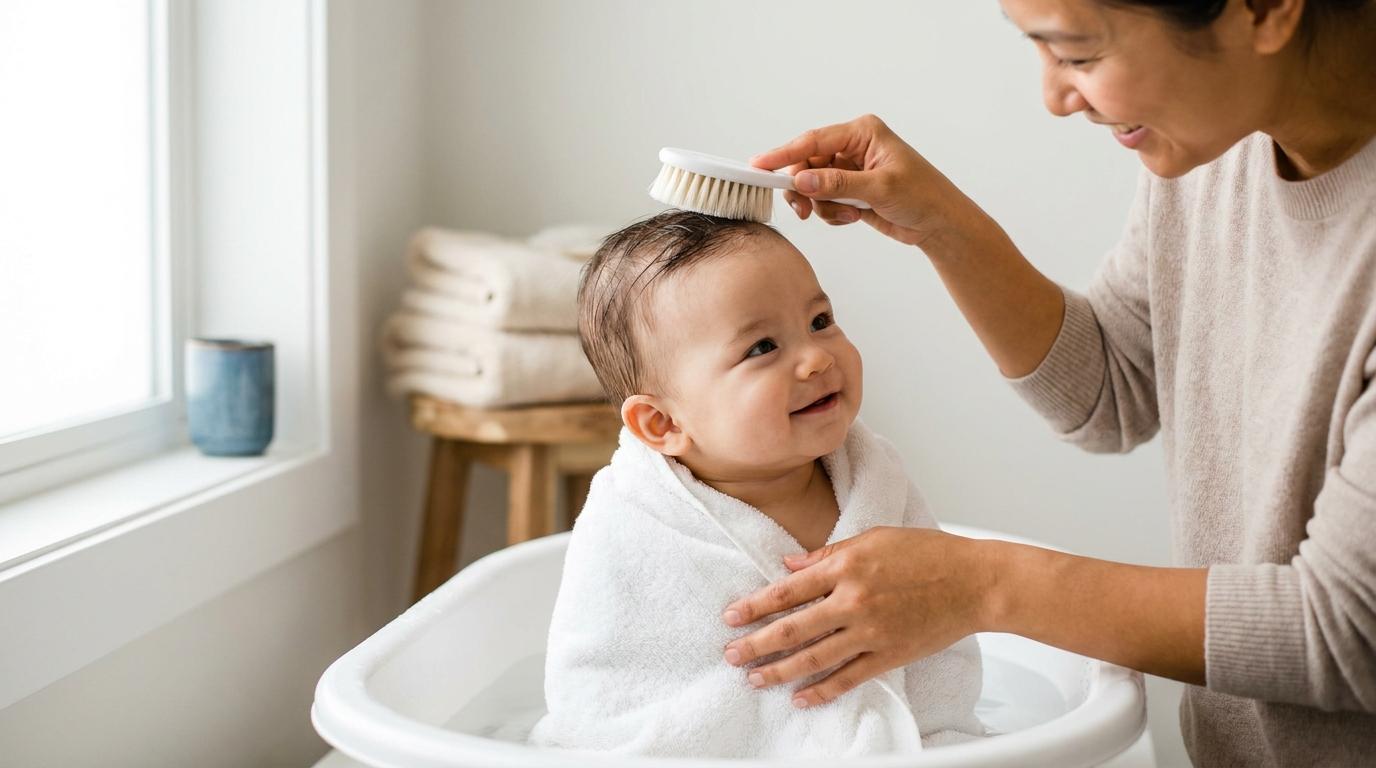
- Gently loosen the softened scales with a soft baby brush or a soft toothbrush. Bath time is a good moment to do this.
- Wash the oil back out with the baby shampoo so it does not build up.
Be patient and gentle. If home care is not enough, your pediatrician may suggest a medicated cream or shampoo. That is a doctor-directed next step, not something to start on your own. For more on newborn scalp and skin care, see our guide on how often to bathe a newborn.
What Not to Do With Cradle Cap
A few common home fixes can do more harm than good. The scales will lift more easily when you are gentle and patient.
- Do not pick, scratch, or scrub the scales off. This can hurt the skin and lead to infection.
- Do not use a stiff brush or scrub hard. A soft brush and light pressure are all you need.
- Do not use medicated, anti-dandruff, or adult products unless your pediatrician says so. That includes over-the-counter steroid creams, antifungal creams, and anti-dandruff shampoos.
- Skip olive oil, and avoid peanut oil because of allergy concerns. Olive oil may not be good for a baby's skin. Dermatologists suggest jojoba oil, coconut oil, or petroleum jelly as safer choices.
Cradle Cap vs. Eczema: How to Tell the Difference
The clearest difference is the itch. Cradle cap is usually not itchy, while eczema is often called "the itch that rashes." If your baby's skin looks irritated and itchy, eczema is more likely.
Location can be confusing, since both can show up on the scalp or face. So lead with two cues: how the skin feels and whether it itches. Cradle cap feels greasy and is usually calm and painless. Eczema feels dry and rough, and it tends to itch. The table below breaks down the main differences.
| Feature | Cradle Cap (seborrheic dermatitis) | Baby Eczema (atopic dermatitis) |
|---|---|---|
| Look | Greasy yellow or white scales, crusty patches | Red or pink rash with bumps on lighter skin; brown, gray, or purple dry patches on darker skin |
| Feel | Oily, greasy | Dry, scaly |
| Itchy? | Usually not itchy | Usually itchy, the "itch that rashes" |
| Where | Mainly the scalp, sometimes brows, behind the ears, or face | Cheeks, forehead, scalp, and later the trunk, arms, or legs |
| Course | Usually clears on its own by about 1 year | Comes and goes, often needs ongoing care |
| Treatment | Gentle home care | Moisturizers, sometimes prescribed treatment |
If your baby's rash sounds more like eczema, our guide on baby eczema walks through what to look for and how to care for it.
When Should You Worry About Cradle Cap? (When to Call a Doctor)
Cradle cap itself is harmless and rarely needs a doctor. The main reason to reach out is to rule out an infection or eczema when you are not sure. When in doubt, a quick check can set your mind at ease.
Watch for signs of infection
Redness, swelling, warmth, pus, bleeding, or a bad smell can mean an infection. Call your pediatrician if you see any of these.
Call your pediatrician, or start a Blueberry telehealth visit, if:
- The rash spreads beyond the scalp onto your baby's face or body, or looks severe.
- The skin is very itchy, painful, or clearly bothers your baby, which points more toward eczema.
- Your baby loses hair in the patchy areas.
- It is not improving after a few months, or it has not cleared by around the first birthday.
A 10-month-old who still has mild cradle cap is usually still normal, since it often clears through the first year. But if it is not getting better after a few months, it is worth a call.
Want a quick read on your baby's scalp?
Start a visitHow a Blueberry Pediatrician Can Help
Cradle cap is one of the most common scalp questions parents ask us about. Most of the time, the answer is simple and reassuring: this is common, harmless, and not your fault.
A telemedicine visit makes it easy to get that answer fast. You can send a photo of your baby's scalp. A pediatrician can tell you whether it looks like ordinary cradle cap. They can also spot something that needs a closer look, like eczema or an infection. With Blueberry Pediatrics, you get 24/7 access to pediatric specialists by message, phone, and video, so you do not have to wonder and wait.
Send us a photo of your baby's scalp
Talk to a pediatricianFrequently Asked Questions
What is cradle cap?
Cradle cap is a common, harmless scalp rash in babies. Its medical name is infantile seborrheic dermatitis, and it causes greasy yellow or white scales.
What does cradle cap look like?
It looks like greasy yellow or white scales and crusty patches, usually on the scalp. The skin underneath may look slightly red.
What causes cradle cap?
Researchers are not certain. They believe it is likely a mix of the mother's hormones making oil glands overactive, plus a harmless skin yeast called Malassezia.
Is cradle cap caused by poor hygiene?
No. It is not caused by poor hygiene, and it is nothing you did.
Is cradle cap an allergy or contagious?
No. It is not an allergic reaction, and it is not contagious. You cannot catch it or pass it to others.
Is cradle cap itchy?
Usually not. Itchy skin points more toward eczema or an infection, so let your pediatrician know if your baby seems bothered.
How do you get rid of cradle cap at home?
Soften the scales with jojoba oil, coconut oil, or petroleum jelly. Then gently loosen them with a soft brush and wash with a mild baby shampoo.
What oil should I use, and what should I avoid?
Plain jojoba oil, coconut oil, or petroleum jelly are good choices. Avoid peanut oil because of allergy concerns.
Is cradle cap the same as eczema?
No. Cradle cap is greasy, yellowish, and usually not itchy, mainly on the scalp. Eczema is dry, itchy, and can appear anywhere. The itch is the biggest clue.
Can cradle cap cause eczema?
No. Cradle cap and eczema are two different conditions. Cradle cap does not turn into eczema, though a baby can have one, the other, or sometimes both.
How long does cradle cap last, and when does it go away?
It usually clears on its own by the first birthday.
My 10-month-old still has cradle cap. Is that normal?
Usually yes, since it often clears through the first year. But if it is not improving after a few months, call your pediatrician.
Can cradle cap get infected?
Yes. Redness, swelling, warmth, pus, bleeding, or a bad smell can mean an infection. Call your pediatrician if you see these signs.
When should I worry about cradle cap?
Call your doctor if the rash spreads beyond the scalp, looks infected, is very itchy or painful, or is not improving after a few months.
Sources
- American Academy of Pediatrics, HealthyChildren.org. Cradle Cap.
- Mayo Clinic. Cradle cap.
- Cleveland Clinic. Cradle Cap (Seborrheic Dermatitis in Infants).
- American Academy of Dermatology. How to treat cradle cap.
- American Academy of Dermatology. Atopic dermatitis (eczema): symptoms.
- Nemours KidsHealth. Cradle Cap (Seborrheic Dermatitis) in Infants.



.svg)




.svg)
.svg)

