


Infant Snoring: When It's Normal and When to Worry


Last Updated: May 3, 2026
Medically Reviewed by: Dr. Melissa Tribuzio, MD, Board-Certified Pediatrician
If your baby snores softly some nights but breathes easily and feeds well, that is almost always normal. Small nasal passages and mild congestion easily produce a snorty sound during sleep. What is not normal is loud snoring most nights, gasping, color changes, or pauses longer than 20 seconds. These are reasons to call your pediatrician, sometimes urgently.
Key Takeaways
- Soft, occasional snoring in babies is usually normal and caused by narrow nasal passages or mild congestion.
- Habitual snoring (3 or more nights per week) is worth a pediatrician visit, even if your baby otherwise seems fine.
- Call 911 if your baby stops breathing for more than 20 seconds, or if any pause comes with blue lips, limpness, or your baby being hard to wake.
- Saline drops and a bulb syringe are the safe first step for congestion-related snoring. Do not prop, tilt, or elevate your baby's head for sleep.
- Do not give over-the-counter cough or cold medicines to children under 4 (FDA warns most strongly against use under 2; many pediatricians prefer under 6).
Is it normal for an infant to snore?
Yes. Soft, occasional snoring is common in babies and usually caused by congestion or a narrow upper airway. Loud, nightly snoring with breathing pauses is not normal and needs a pediatrician.
A baby's nose and airway are tiny, so even mild mucus or a turned head can produce a snorty sound, usually during a cold, and usually gone as your baby grows.
Snoring vs. stridor vs. wheezing: snoring is low-pitched, from the nose or throat. Stridor is a high-pitched inhaling squeak from the voice box, most often laryngomalacia in infants. Wheezing is a whistle on exhale, often bronchiolitis (RSV). If you are not sure what you are hearing, record a 30-second video with the room quiet.
Common causes of normal infant snoring
Most baby snoring traces back to one of four benign causes: colds and dry air, naturally narrow nasal passages, sleep position, or milk reflux into the back of the nose.
- Nasal congestion. A cold, dry air, smoke, dust, or a bit of milk in the nasopharynx can narrow the nose. By far the most common cause we see in clinic.
- Naturally narrow nasal passages. Even healthy babies have small airways; a trace of mucus can produce audible noise that improves as your baby grows.
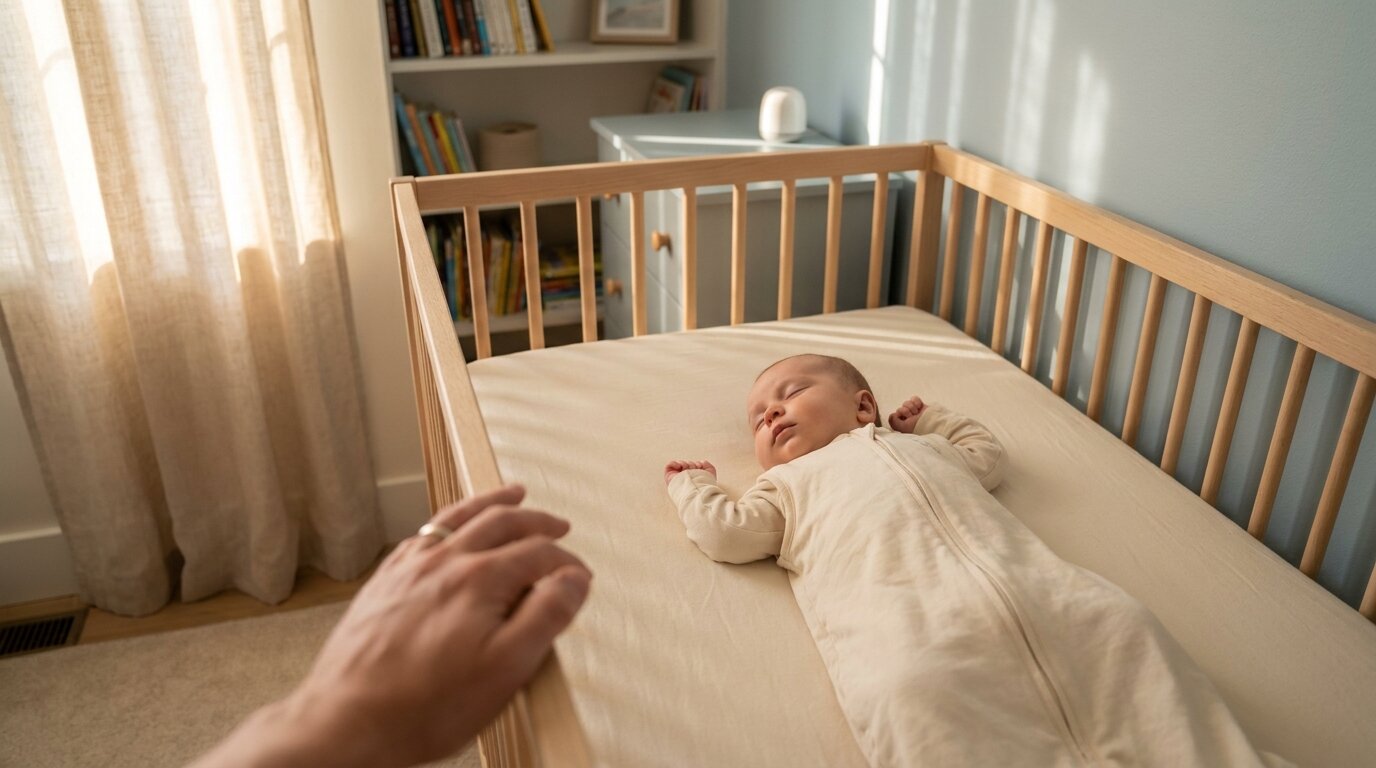
- Sleep position. A chin tucked to the chest or a sharply turned head can compress the airway. Keep your baby on the back, on a firm flat surface, head neutral.
- Reflux into the back of the nose. If snoring is loudest in the hour after a feed, milk in the nasopharynx may be the culprit. Burp well and hold your baby upright for 15 to 20 minutes after feeds (while awake).
If your baby is feeding well, gaining weight, and snoring fades between colds, you are almost certainly in this benign range. Related: newborn sleep with mouth open.
When infant snoring is a sign of something more serious
Persistent, loud, or labored snoring can signal an anatomic problem, allergies, or (rarely) obstructive sleep apnea, especially in babies with risk factors like Down syndrome or craniofacial differences.
- Enlarged adenoids and tonsils. The classic cause of habitual snoring, but uncommon under 1. Adenoid tissue peaks at ages 3 to 7 and tonsils after age 5 (Marcus 2012).
- Laryngomalacia. The leading anatomic cause of noisy breathing in infants. It produces stridor (a high-pitched inhaling squeak), not true snoring; about 9 in 10 cases are mild and resolve by 12 to 24 months (AAP HealthyChildren).
- Choanal atresia or stenosis (a rare narrowing at the back of the nose). Bilateral cases are usually caught in the newborn nursery; one-sided cases can show up later as one-sided congestion.
- Irritants and allergies. True allergies are uncommon in the first year; irritant congestion from smoke, fragrances, pet dander, or dust is common.
- Obstructive sleep apnea (OSA). Real but uncommon under 1. Risk rises with Down syndrome, craniofacial differences such as Pierre Robin sequence (a small jaw with a tongue that can fall back) or micrognathia (an underdeveloped jaw), severe laryngomalacia, very low muscle tone, achondroplasia (a bone-growth condition affecting skull and airway shape), or chronic lung disease of prematurity (Marcus 2012). In babies, untreated OSA most often shows up as poor feeding and slow weight gain.
A note on "pauses." Pauses under 10 seconds followed by faster catch-up breaths are periodic breathing of infancy and are normal in the first 6 months (AAP HealthyChildren). A pause over 20 seconds, or any pause with blue lips, limpness, or unresponsiveness, is apnea. Call 911. An 11- to 19-second pause without color change warrants a same-day call.
Red flags: when to call your pediatrician (and when to call 911)
Call 911 for pauses over 20 seconds or any pause with blue color, limpness, or unresponsiveness. Call your pediatrician for habitual snoring, gasping, retractions, poor feeding, or poor weight gain.
Call 911 now if:
- Your baby stops breathing for more than 20 seconds.
- Any pause comes with blue lips, blue face, limpness, or your baby is hard to wake.
- Your baby looks like they are working very hard to breathe and is not improving.
Call your pediatrician today if:
- Your baby snores loudly most nights, even when not sick, or has lasted more than 2 weeks without an obvious cold.
- Your baby is gasping, choking, or audibly struggling during sleep.
- You see retractions (skin between or below the ribs pulls in with each breath), nasal flaring, a see-saw belly-and-chest pattern, or unexplained sweating during sleep.
- Your baby is mouth-breathing while awake, gagging during feeds, or fatiguing quickly while feeding.
- Your baby is not gaining weight as expected.
A note on color: the worrisome blue is around the lips, tongue, or center of the face, not hands or feet. Slightly bluish hands and feet (acrocyanosis) are normal in newborns.
How to help a congested, snoring infant sleep
Saline drops and a bulb syringe, a cool-mist humidifier, steam, and steady feeds are the safe home-care steps. Do not prop or tilt the head, and do not give OTC cold medicines under 4.
Do:
- Saline drops, then suction. 2 to 3 drops of saline per nostril, wait 30 seconds, then use a bulb syringe; best 15 to 20 minutes before feeds and bedtime.
- Run a cool-mist humidifier; clean and dry it daily.
- Steam time. Hot shower running, bathroom door closed; sit with your baby in the steam (not in the shower) for about 10 minutes.
- Keep feeds on the usual schedule. Babies under 6 months should not be given water.
- Keep sleep flat: back, firm flat surface, no blankets, pillows, bumpers, or wedges. See: safe sleep positions.
Do not:
- Do not prop, tilt, or use a wedge or inclined sleeper. The AAP is explicit: babies must sleep flat on their backs on a firm flat surface; the CPSC has banned inclined infant sleepers.
- Do not give OTC cough or cold medicines (decongestants, antihistamines) to children under 4 (FDA); under 2 is the most dangerous band, and many pediatricians prefer under 6.
- Do not use Vicks VapoRub or other camphor or menthol products in babies under 2.
- Do not use essential oils in a humidifier or diffuser around infants without your pediatrician's input.
If snoring comes with a barky cough or hoarse cry, see our croup treatment guide.
How pediatricians diagnose infant snoring concerns
We start with a careful history, an in-office exam, and often a 30-second phone video of a sleep episode. If we suspect sleep apnea, we refer to a pediatric ENT or sleep specialist for an overnight sleep study.
Expect your pediatrician to ask when the snoring started, whether it is nightly or only with colds, whether your baby pauses or changes color, how feeding and weight gain are going, family history, and home exposures (smoke, vape, pets, mold). The definitive OSA test is an overnight pediatric sleep study (polysomnography); home sleep tests are not reliable in babies.
How Blueberry Pediatrics can help
Most infant snoring questions can be triaged over a video visit: a pediatrician listens to your baby's breathing, watches a short sleep video, and coaches you through saline-and-suction.
In a typical visit, a Blueberry pediatrician will:
- Listen to your baby's breathing and review your sleep video for retractions, nasal flaring, mouth breathing, or feeding fatigue.
- Walk you through saline drops and bulb-syringe technique.
- Decide together whether your baby needs urgent in-person evaluation or home care and follow-up.
To talk to a Blueberry pediatrician 24/7 about your baby's snoring, start a Blueberry visit.
Common questions about infant snoring
Is it normal for a baby to snore?
Soft, occasional snoring is common and usually normal, especially during a cold or in dry air. Loud snoring most nights, snoring with pauses or gasps, or snoring with poor feeding or weight gain is not normal and is worth a pediatrician visit.
Why does my newborn snore?
Most newborn snoring comes from a narrow, easily congested nose. Mucus, dry air, a bit of milk in the back of the nose, or a chin-tucked head can all create snoring sounds, and they typically clear as your baby grows.
When should I worry about my baby snoring?
Call your pediatrician if your baby snores loudly most nights, gasps during sleep, has visible chest retractions, mouth-breathes while awake, has trouble feeding, or is not gaining weight. Call 911 for any pause over 20 seconds or with blue lips, limpness, or unresponsiveness.
Can babies have sleep apnea?
Yes, but obstructive sleep apnea is uncommon in healthy babies under 1. Risk goes up with Down syndrome, craniofacial differences, severe laryngomalacia, very low muscle tone, or chronic lung disease of prematurity. The diagnostic test is an overnight pediatric sleep study.
What causes infant snoring?
Top everyday causes are nasal congestion (cold, dry air, milk reflux), naturally narrow nasal passages, and sleep position. Less commonly: enlarged adenoids or tonsils, laryngomalacia (which causes stridor, not snoring), irritants, allergies, or obstructive sleep apnea.
How do I help my congested baby sleep?
Use saline drops, then a bulb syringe, 15 to 20 minutes before feeds and bedtime. Run a cool-mist humidifier. A bathroom steam session (shower running, baby in your arms) can loosen mucus. Do not prop the head or give OTC decongestants to children under 4.
Should I take my snoring baby to the doctor?
If the snoring is brief, soft, and tied to a cold, watch and wait. If it lasts more than 2 weeks without a cold, happens most nights, or comes with gasps, retractions, poor feeding, or poor weight gain, schedule a visit. Telehealth is a good first step.
Does infant snoring go away?
Most benign snoring clears with the cold that caused it, usually in 1 to 2 weeks. Laryngomalacia can take 12 to 24 months. Enlarged adenoids in older children and true sleep apnea do not resolve on their own and need treatment.
Medical disclaimer
This article is general information and is not a substitute for medical advice. If you are worried about your baby's breathing, contact your pediatrician or call 911 in an emergency.
Concerned about your baby's snoring? Talk to a Blueberry pediatrician 24/7 from the comfort of home.


.svg)




.svg)
.svg)

