


How to Potty Train Boys: A Pediatrician's Step-by-Step Guide


Last reviewed and updated April 2026 for current AAP guidance on toilet training readiness, sit-vs-stand progression, and pediatric constipation.
Key Takeaways
- Readiness is about signs, not a number. Boys usually show them between 22 and 30 months.
- Boys reach milestones a few months later than girls on average. Within-boy variation is larger than the gender gap.
- Start with sitting for both pee and poop. Standing comes later, when your son is ready.
- Nighttime dryness is biology, not training. Bedwetting past age 4–6 is common and not a failure.
- Remove pressure around poop. If he asks for a diaper to poop, give him one for now.
- Call the pediatrician for a weak urine stream, constant dribbling, painful stools, or no progress by age 3.5–4.
When Are Boys Ready to Potty Train?
Most boys show readiness signs between 22 and 30 months. Start by watching for signs, not by picking a date.
Most boys are ready to start potty training between 22 and 30 months. Pediatric convention is to introduce the potty around 18 months, then start real practice once your son shows readiness signs. Average US start age is 2 to 3, and most boys are daytime-trained by age 4 — bedwetting is a separate biological milestone, covered below. Potty training boys works best when the child leads the timing, not the calendar.
Signs Your Son Is Ready for Potty Training
You do not need every sign. Two or three from each group is a reasonable green light.
Readiness shows up in the body, the brain, and the emotions.
Body signs:
- Stays dry for at least 2 hours in the day, or wakes dry from naps.
- Has regular, predictable bowel movements.
- Can walk to the bathroom and help with pants up and down.
- Pauses, squats, grunts, or hides right before going.
Brain and language signs:
- Follows simple instructions.
- Has words or signs for pee and poop, even family ones.
- Understands cause and effect, and knows the wet feeling came from the pee.
Emotional and social signs:
- Is bothered by a wet or dirty diaper and wants a change.
- Wants to do things "by myself."
- Watches a parent or older sibling use the toilet with interest.
- Asks to wear underwear or "big-kid pants."
If most signs are missing, wait a few weeks and watch again. Pushing past a clear "not ready" is linked to longer overall training time.
Should Boys Learn to Pee Sitting or Standing First?
Sitting first. It is the standard pediatric approach for stability, bowel coordination, and complete bladder emptying.
The AAP puts it plainly: "Boys can urinate by sitting down first and can stand up to urinate when better at it." There is no recommended age for the standing transition. Sit-first is practical convention, not a strict rule.
Four reasons pediatricians favor sitting first:
- Stability. Toddlers sit steadier than they stand still. A stable trunk lets the pelvic floor (the muscles that support the bladder and bowel) relax, and that is how urine and stool actually come out.
- One skill at a time. Sitting for pee and poop cuts cognitive load. Aim is a lot to add on top of noticing the urge and getting to the toilet.
- Bowel coordination. Boys still need to sit for stool. If he learns "stand equals pee," he may refuse to sit for a poop. That pattern is a common cause of stool withholding.
- Complete emptying. Rushing a stand-up pee can leave the bladder partly full. Sitting builds a calm, complete void.
Switch to standing when sitting is solid, accidents are rare, and he can stand still. Many families transition between ages 3 and 4. Later is fine.
Step-by-Step Potty Training Plan for Boys
Four stages: introduce, practice sitting, add standing, and wait out nighttime. Move at your son's pace, not a deadline.
1. Introduce the Potty
Start around 18 months, or whenever your son is curious. Keep it low-pressure.
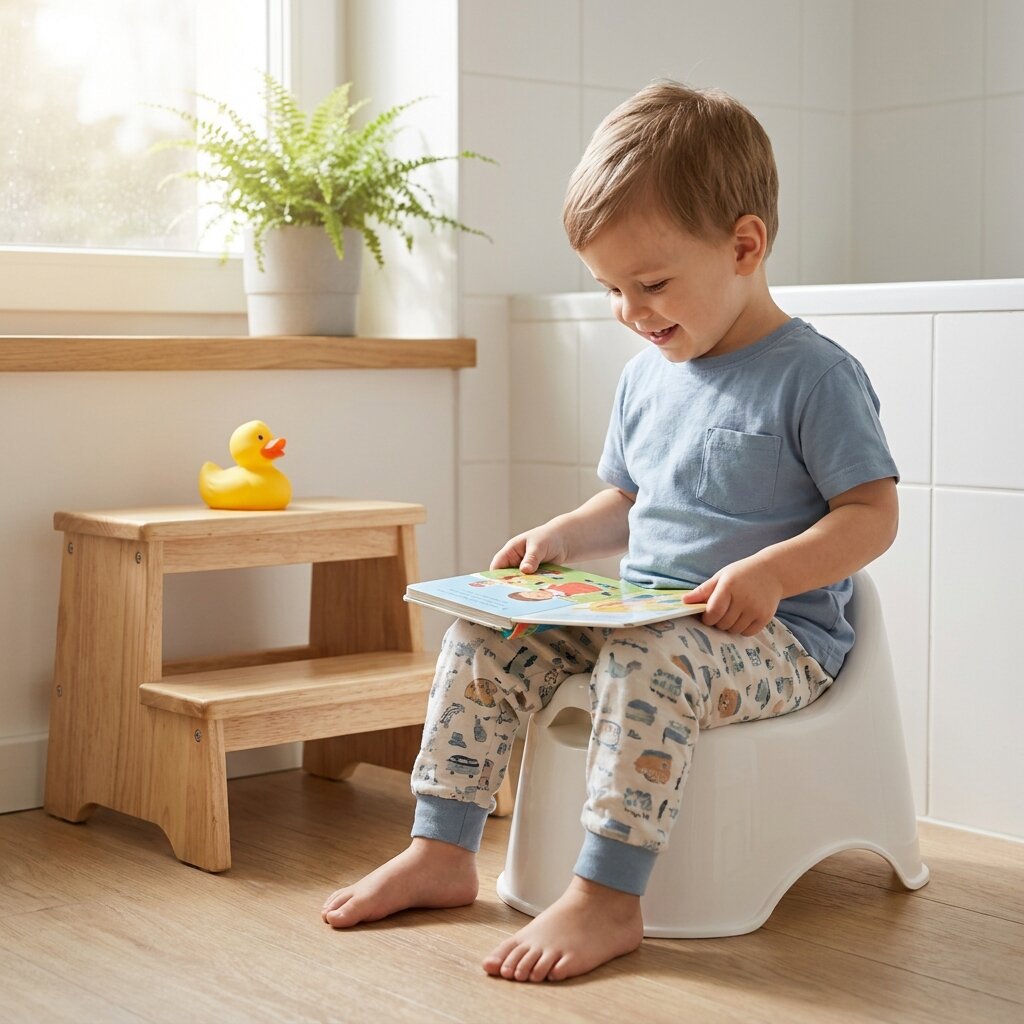
- Buy a floor-level potty chair. Feet on the floor matters for stability.
- Let him sit on it fully clothed. Make it normal furniture in the bathroom.
- Read potty books. Let him watch a parent or older sibling use the toilet. Modeling is the highest-yield teaching tool at this age.
- Use simple, consistent words for pee and poop. Match them at daycare.
The goal here is familiarity, not performance.
2. Practice Sitting
Start when readiness signs appear, often 21–30 months. Keep sessions short and neutral.
- Schedule 3–5 minute sits at high-success moments: after waking, 15–30 minutes after meals, before bath.
- Both pee and poop happen sitting, for the entire training period.
- Give specific praise: "You peed on the potty, great job!" It works better than a generic "good boy."
- Stay calm about misses. "Oops, that's okay." Scolding is linked to stool withholding and longer training.
- Dress for success. Elastic-waist pants only. Skip overalls, belts, and snaps.
3. Transition to Standing (When the Time Comes)
No fixed age. Move on when sitting is reliable and daytime accidents are rare.
- Check that he can stand still and can reach the bowl with a step stool.
- Have dad, an older brother, or another trusted male demonstrate. Modeling works best here.
- Try a simple aim target, like a Cheerio or a bit of toilet paper in the bowl. Skip commercial targets with small parts.
- Allow sitting at any time, forever. Sleepy boys often prefer to sit. That is not regression.
4. Nighttime Training (Usually Later)
Nighttime dryness is a biological milestone, not a learned skill. You cannot speed it up.
- A daytime-trained 3-year-old still in a nighttime pull-up is normal.
- Use pull-ups without shame. Add a waterproof mattress cover.
- Keep fluids light in the last hour before bed.
- Skip scheduled night-wakings. They disrupt sleep without speeding maturation.
- Bedwetting alarms can help motivated families with a child age 6 or older.
Common Challenges When Potty Training Boys
Aiming, toilet fears, regression, and stool holding are the usual four. None is a sign training has failed.
Aiming Practice and Making It Fun
Wet floors during the standing phase are universal. Treat it as a target problem, not a behavior problem — a step stool, a target in the bowl, and cleaning supplies nearby solve most of it. Don't shame a missed aim: the bigger risk is the boy who tightens his pelvic floor to "be perfect," which leads to incomplete voids and later constipation.
Fear of the Toilet
The auto-flush sensor in public restrooms is a top fear trigger. A sticky note over the sensor is the quick fix. Splash, loud flushes, and "things go down" are real toddler fears, not stalling. Stay with the floor-level potty at home until the fear fades.
Regression and Accidents
Regression is common and usually benign. AAP-listed triggers include a new sibling, new daycare, illness, family stress, a move, a UTI, or constipation — most episodes pass in days to weeks. Call the pediatrician for any regression that isn't quickly explained by a known trigger; AAP recommends ruling out a physical cause (especially UTI) first. If it drags past a month, pause training rather than pushing harder.
Holding Poop and Constipation Concerns
This is the biggest medical issue in potty training. One painful stool leads to clenching. Stool dries. The next one hurts more. The child holds harder. About 1 in 5 children refuse to poop on the potty at some point (Taubman 1997).
Remove the pressure instead of pushing through it.
- If he asks for a diaper to poop, give him one. It is temporary.
- Keep stools soft: water, fruit, vegetables, whole grains.
- Do not start a stool softener on your own. Ask your pediatrician first.
Most kids grow out of stool refusal within months once the fight ends.
How Long Does It Take to Potty Train a Boy?
Most boys take 3 to 6 months from start to reliable daytime dryness. Some finish in weeks; some take close to a year.
The biggest factor is readiness. Children who start before their readiness signs emerge almost always take longer overall (consistent with Blum et al. 2003, which found intensive training before 27 months did not shorten duration). Starting late is rarely a medical concern, but one study found training initiated after 32 months was associated with later urge incontinence (Barone 2009). When in doubt, start when readiness signs appear.
Daycare consistency matters. Align vocabulary, schedule, and clothing with caregivers; mismatch is a top reason training stalls. Send extra clothes daily.
Potty Training Myths About Boys (and the Truth)
Five myths that make potty training harder than it needs to be, with what the evidence actually says.
- Myth: Boys are harder to train than girls. The gap is about 2 to 3 months across milestones on average (Schum 2002). Within-boy variation is larger than the gender gap. Many boys finish before many girls.
- Myth: Bedwetting means training failed. Bedwetting is biology. Overnight bladder capacity and vasopressin (the brain's "hold the urine" hormone) mature at their own pace. Boys outnumber girls about 2 to 1 overnight at every age.
- Myth: If he holds poop, he is being stubborn. Stool withholding is almost always a response to pain or pressure, not defiance. Removing the pressure is the fix.
When to Talk to a Pediatrician
Most potty training boys issues resolve on their own. These signs deserve a call.
- No readiness signs and no progress by age 3.5–4 despite consistent, patient effort.
- A weak, dribbling, or sideways-pointing urine stream, or straining to start. This is a boys-specific concern that needs prompt evaluation.
- Constant urine dribbling between voids (continuous wetness, not episodic accidents).
- Pain or burning with urination. A UTI should be ruled out.
- Hard, painful, or infrequent stools lasting more than 2 weeks, or visible blood.
- Soiling accidents in a previously trained child. This is usually retentive constipation (stool withheld long enough to dry and harden in the rectum), and it is treatable.
- Sudden regression with thirst, weight loss, frequent urination, or fatigue. New-onset diabetes should be ruled out.
- Sudden regression with leg weakness, gait change, or back pain. Rare, but urgent.
- Daytime wetting past age 5–6.
- Bedwetting past age 7, or a return of bedwetting after 6 months of dryness.
In our own telehealth visits, the pattern is consistent: most calls about regression trace back to an unnoticed UTI, an underestimated constipation pattern, or a recent life-stressor, not a motivation problem. Naming the trigger usually de-escalates the situation within days.
Have potty training concerns? Message a Blueberry pediatrician 24/7 (blueberrypediatrics.com). Our board-certified pediatricians see parents through every stage of potty training: readiness, regression, constipation, bedwetting, and the questions that come up at 10 p.m. on a Tuesday.
FAQ: Potty Training Boys
Answers to the ten questions parents of boys ask most often, from readiness age to bedwetting.
At what age should I potty train my boy?
Most boys show readiness signs between 22 and 30 months. Pediatric convention is to introduce the concept around 18 months, and starting practice when readiness signs appear. Average US start age is 2 to 3. Most children are trained by age 4.
Is it harder to potty train boys than girls?
Not really. Boys reach milestones about 2 to 3 months later than girls on average (Schum 2002). Individual variation is wider than the gender gap. The gap mostly reflects small differences in language pace and the extra step of learning to stand later.
Should I teach my son to pee sitting or standing first?
Sitting first. Per AAP: "Boys can urinate by sitting down first and can stand up to urinate when better at it." Sitting is more stable, relaxes the pelvic floor, keeps pee and poop on one routine, and avoids the common refusal where a boy who "graduated" to standing will not sit for a bowel movement.
How do I get my son interested in using the potty?
Modeling is the single biggest predictor. Modeling by dad, an older brother, or an uncle is the highest-yield strategy we see — boys often refuse to sit until they watch a male family member go through the motions. Supplement with potty books, friendly videos, and a designated potty that is "his" and lives in the main bathroom. Keep the tone matter-of-fact, not performative. Reward effort, not only outcomes: "You sat on the potty, great try." Avoid sticker charts that tie worth to successes, especially early; they can backfire into withholding.
How long does it take to potty train a boy?
On average, 3 to 6 months from first real sit to reliable daytime dryness. Some boys finish in weeks; others take close to a year. The biggest predictor is readiness, not age: starting before readiness signs appear almost always extends the overall process. In practice, a 24-month-old with all the signs can finish faster than a 30-month-old without them. Nighttime dryness is a separate, slower biological milestone — expect it to trail daytime training by months to years, and don't treat night pull-ups as a setback.
What if my son refuses to poop on the potty?
This is stool toileting refusal, and it affects about 1 in 5 children. Remove the pressure. If he asks for a diaper to poop, give him one. Keep stools soft with water, fruit, and whole grains. Most kids grow out of it within a few months. Forcing it causes stool withholding and a much longer process.
How do I handle accidents?
Stay calm and neutral. A simple "Oops, that's okay, we'll try next time" is the full script. No scolding, no visible frustration, no "big-boy" shaming — scolding is consistently linked to stool withholding and longer overall training. Have your son help clean up in a matter-of-fact way (bring wet clothes to the hamper), not as punishment. Keep a water bottle and fresh undies within arm's reach at home so accidents are a three-minute event. If accidents cluster — more than 2–3 a day for over a week after dry stretches — pause, rule out constipation or a UTI, and call the pediatrician.
When should I start nighttime potty training?
You do not, exactly. Nighttime dryness is biological maturation, not a learned skill. Use pull-ups at night without shame until your son is waking up dry on his own. Many boys are not reliably dry overnight until age 4 to 6. About 15% of 5- and 7-year-olds still wet the bed regularly.
Are there signs my son isn't ready yet?
Yes, and they are worth respecting. Resistance to sitting, no interest in the bathroom, meltdowns when reminded, no awareness of being wet, no "tells" before going. If most of the readiness list is missing, pause a few weeks and try again.
When should I see a pediatrician about potty training issues?
See the "When to Talk to a Pediatrician" section above. Short list: weak or dribbling stream, constant dribbling, painful stools or blood, unexplained regression, daytime wetting past age 5–6, and bedwetting past age 7.
For a gender-neutral overview of readiness, methods, and general tactics, see our companion guide: Potty Training Tips.
This article is for education, not medical advice. For questions about your child's health, message a Blueberry pediatrician or contact your primary care provider.
Sources
- American Academy of Pediatrics. "Toilet Training." HealthyChildren.org.
- American Academy of Pediatrics. "The Right Age to Potty Train." HealthyChildren.org.
- American Academy of Pediatrics. "How to Tell When Your Child is Ready." HealthyChildren.org.
- American Academy of Pediatrics. "Create a Potty Training Plan for Your Child." HealthyChildren.org.
- American Academy of Pediatrics. "Potty Training Regression." HealthyChildren.org.
- American Academy of Pediatrics. "Bedwetting: 3 Common Reasons & What Families Can Do." HealthyChildren.org.
- Schum TR, et al. "Sequential acquisition of toilet-training skills." Pediatrics. 2002;109(3):E48.
- Barone JG, Jasutkar N, Schneider D. "Later toilet training is associated with urge incontinence in children." J Pediatr Urol. 2009;5(6):458–61.
- Blum NJ, Taubman B, Nemeth N. "Relationship between age at initiation of toilet training and duration of training." Pediatrics. 2003;111(4 Pt 1):810–4.
- Taubman B. "Toilet training and toileting refusal for stool only." Pediatrics. 1997;99(1):54–8.



.svg)





.svg)
.svg)

