


Newborn Sleeping Through the Night: A Pediatrician's Guide


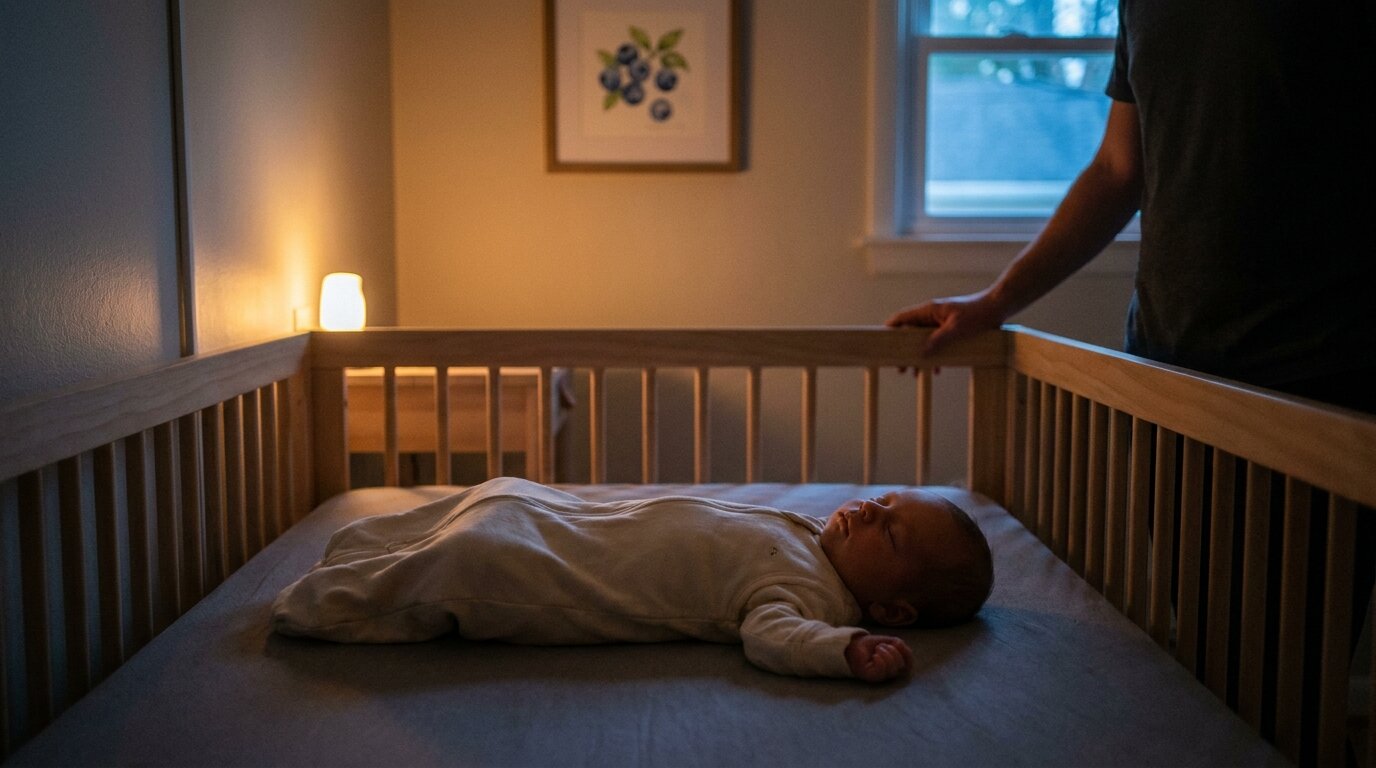
Most babies start sleeping in stretches of 5 to 6 hours by 3 to 4 months. Every baby's pattern is different. And "sleeping through the night" does not mean 8 to 12 straight hours, especially in the first few months. Below, a pediatrician explains what the phrase really means at each age, what you can safely do to help, and the safe-sleep rules from the American Academy of Pediatrics (AAP).
Key Takeaways
- "Sleeping through the night" usually means one stretch of about 5 to 6 hours, not a full adult night.
- Most healthy, term babies hit 5 to 6 hour stretches by 3 to 4 months; longer 8 to 10 hour stretches arrive between 6 and 9 months.
- Newborns under 3 months need to feed every 2 to 4 hours. Do not push longer stretches.
- Safe sleep, every sleep: on the back, alone, in a flat firm crib or bassinet in your room.
- A pacifier at sleep time helps lower the risk of SIDS (Sudden Infant Death Syndrome).
- A "good sleeper" is a baby who briefly wakes and resettles, not one who never wakes.
- Call your pediatrician if your baby is over 6 months and still waking every 1 to 2 hours.
What "Sleeping Through the Night" Actually Means
Most parents picture an 8 to 12 hour stretch with no wake-ups. That is not what pediatricians mean by this phrase, at least not in the first year.
In the medical world, "sleeping through the night" in young babies is one stretch of about 5 to 6 hours. By 6 months, many healthy babies extend that to 8 to 10 hours, often with one or two brief wake-ups along the way.
The AAP reframes the goal this way: a good sleeper briefly wakes during the night but can get themselves back to sleep. The skill is the resettle, not the absence of waking. Brief night waking is biology, not failure.
What's Normal at Each Age
Sleep needs change fast in the first year. Most healthy babies sleep 12 to 17 hours per day, with longer night stretches arriving between 3 and 9 months. Use these as guideposts, not targets. If your baby is feeding well, gaining weight, and acting like themselves during the day, their sleep is probably fine.
0 to 3 Months (Newborn)
- Total sleep: about 14 to 17 hours per 24 hours.
- Longest stretch: usually 2 to 4 hours. Some reach 5 to 6 hours by 8 to 12 weeks.
- Feeding: every 2 to 3 hours if breastfed, every 3 to 4 hours if formula-fed. Never go longer than about 4 to 5 hours between feeds until your pediatrician confirms steady weight gain.
- Day-night confusion is normal through about 6 weeks. Your baby's body clock is still wiring up.
3 to 6 Months
- Total sleep: about 12 to 16 hours per 24 hours.
- Longest stretch: many babies extend to 5 to 8 hours. Some still wake more often. Both are normal.
- Feeding: many term babies, especially formula-fed, are ready to drop scheduled night feeds in this window once your pediatrician confirms steady weight gain. Breastfed babies may continue to feed at night through 6 months and beyond, which is normal.
- This is the most common window for longer night stretches to show up. In our Blueberry telehealth visits, the most common parent question lands right around the 4-month mark, when a temporary sleep regression hits and parents wonder if something is wrong. Usually it is not.
6 to 9 Months
- Total sleep: about 12 to 15 hours per 24 hours.
- Longest stretch: 8 to 10 hours is common. Most no longer need calories at night.
- Brief wake-ups are still normal. Separation anxiety can also kick in and bring back some night waking.
9 to 12 Months
- Total sleep: about 12 to 15 hours per 24 hours.
- Longest stretch: 10 to 12 hours with zero or one brief wake-up.
- Babies in this range no longer have a nutritional need for night feeds. Waking every 1 to 2 hours is a reason to call your pediatrician.
What You Can Safely Do to Help
Three habits drive most newborn-sleep wins: a calm bedtime routine, clear day-night cues, and the AAP safe-sleep setup. These tips are for healthy babies older than a few weeks. Your pediatrician should clear longer stretches for your specific baby.
Build a calm bedtime routine
Build a calm, predictable bedtime routine. Start around 6 to 8 weeks. Bath, feed, book, song, lights out. The same short routine cues your baby's brain that sleep is next.
Lean into the day-night difference. Keep days bright and active. Keep nights dim, quiet, and short on talking, even during feeds. That helps your baby's body clock sort itself out faster.
Put your baby down drowsy but awake when you can. Babies who fall asleep in the crib can usually fall back asleep there too. Babies who fall asleep nursing or being rocked may need that same help at 3 a.m.
Safe-sleep setup
Offer a pacifier at sleep time. The AAP recommends a pacifier at naps and bedtime because it lowers the risk of SIDS. For breastfed babies, wait until nursing is well established, usually around 3 to 4 weeks. If it falls out after your baby is asleep, you do not need to put it back in.
Share your room, not your bed, for the first 6 months. The AAP recommends keeping your baby in your room, in their own crib or bassinet, for at least 6 months. Room-sharing makes night feeds easier and lowers the risk of SIDS. Bedsharing is different from room-sharing, and is not recommended.
Watch the swaddle window. Swaddling can help in the first weeks. Stop as soon as your baby shows any signs of trying to roll. For some babies that is around 2 months, but every baby is different. Then switch to an arms-out sleep sack.
Talk to your pediatrician before any sleep training. Methods that involve any amount of letting your baby cry are not appropriate before 4 months. After that, your pediatrician can help you choose an approach.
If your nights still feel impossible, you can Talk to a Blueberry pediatrician the same night. No need to wait until morning.
What NOT to Do
These are firm safety rules from the AAP's 2022 safe-sleep guidelines. They apply to every sleep, including naps.
- Do not bedshare. The AAP does not recommend bedsharing under any circumstances. Sleeping with your baby on a couch, recliner, or armchair carries the highest risk of all.
- Do not use weighted swaddles, weighted sleep sacks, or weighted blankets. This includes tucking any weighted object into a regular swaddle.
- Do not use inclined sleepers, pillows, wedges, or sleep positioners. Your baby's sleep surface should be flat and firm.
- Do not keep crib bumpers, blankets, pillows, or stuffed animals in the crib. A bare crib is the safest crib.
- Do not let a newborn under 3 months go too long between feeds. Pushing a brand-new baby past their feeding window can cause poor weight gain and dehydration.
- Do not place your baby on their stomach or side to sleep. Back to sleep, every sleep, until your baby can roll both directions on their own.
When to Talk to Your Pediatrician
Call your pediatrician if your baby snores loudly, has visible breathing pauses, is not feeding or growing well, or is still waking every 1 to 2 hours after 6 months. Most "is this normal?" sleep questions have a normal answer. A few do not. Call your pediatrician (or seek urgent care) for any of the following:
- Snoring, gasping, or breathing pauses during sleep. Loud nightly snoring, visible pauses, or choking sounds can be signs of obstructive sleep apnea (when breathing repeatedly stops or shallows during sleep). Also watch for mouth breathing during sleep, sleeping in unusual positions to keep the airway open, or persistent nighttime sweating. These can be earlier signs of sleep-disordered breathing (a spectrum of breathing problems during sleep that can affect rest and growth). It is treatable and should not be ignored.
- Poor feeding or poor weight gain. Fewer than 6 wet diapers a day after the first week of life, falling off the growth curve, or long sleep stretches paired with sleepy feeds need a same-day call.
- A baby older than 6 months still waking every 1 to 2 hours. Or a baby who was sleeping well and suddenly is not. Ear infections, reflux, and sleep-disordered breathing can show up this way.
- Anything that feels off. You know your baby. If your gut says something is wrong, call.
If your baby has colicky crying patterns mixed in with sleep struggles, our guide to colic can help you sort out what is what. For a deeper look at sleep cycles by month, see our guide to baby sleep cycles and milestones, birth to 12 months.
If you would rather just ask a pediatrician at 2 a.m. than scroll, you can Talk to a Blueberry pediatrician any time.
Frequently Asked Questions
When do newborns start sleeping through the night?
Most healthy, term babies sleep one stretch of 5 to 6 hours by 3 to 4 months. Many extend to 6 to 8 hours by 3 to 6 months. Longer 8 to 10 hour stretches usually show up between 6 and 9 months. Some babies do not sleep that long until closer to their first birthday, and that can still be normal.
How many hours is "sleeping through the night" for a newborn?
For babies under 6 months, pediatricians often count one stretch of about 5 to 6 hours as "through the night." Longer 8 to 12 hour stretches are not realistic for most babies until at least 6 months. A good sleeper wakes briefly and can resettle.
Is it safe for a newborn to sleep through the night without feeding?
Not in the first few weeks. Newborns should not go longer than about 4 to 5 hours between feeds until they are back to birth weight and gaining steadily, usually by 2 to 3 weeks. After your pediatrician confirms steady growth (often around 3 months and 12 to 13 pounds), longer stretches are typically safe.
How can I help my newborn sleep longer at night?
Keep days bright and active, nights dim and quiet. Start a short bedtime routine around 6 to 8 weeks. Put your baby down drowsy but awake. Offer a pacifier at sleep time. And follow safe-sleep rules every time.
Why won't my baby sleep through the night?
Common reasons include growth spurts, teething, milestones like rolling or crawling, separation anxiety, illness, and sleep associations. A previously good sleeper who suddenly stops sleeping well is worth a pediatrician call. Ear infections and other treatable issues can show up as new night waking.
When should I worry about my baby's sleep?
Call your pediatrician if your baby snores loudly most nights, has visible breathing pauses, or works hard to breathe during sleep. Also call if your baby is over 6 months and still waking every 1 to 2 hours, is not gaining weight, or if good sleep suddenly falls apart.
Is it safe to bedshare with my newborn?
No. The AAP does not recommend bedsharing under any circumstances. The safest setup for the first 6 months is room-sharing: your baby in their own crib or bassinet in your room. Sleeping with your baby on a couch, recliner, or armchair is the highest-risk setting and should never happen.
Why is SIDS highest at 2 to 4 months?
SIDS peaks between 2 and 4 months because babies in this window are old enough to shift positions but not yet able to reliably reposition themselves if their airway becomes blocked. The AAP-recommended steps (back-to-sleep for every sleep, a flat firm crib or bassinet, and room-sharing instead of bedsharing) lower this risk. SIDS risk drops sharply after 6 months.
Get a Pediatrician on Demand
Sleep questions never wait for business hours. Blueberry Pediatrics gives you 24/7 access to a board-certified pediatrician through your phone, plus a kit with an otoscope, thermometer, and pulse oximeter. Your doctor can actually see and hear what is going on. No urgent-care lines, no copays per visit, no waiting until Monday.
Want a pediatrician on call for the rough nights?
Talk to a pediatricianReferences
- Moon RY, Carlin RF, Hand I; AAP Task Force on Sudden Infant Death Syndrome. Sleep-Related Infant Deaths: Updated 2022 Recommendations for Reducing Infant Deaths in the Sleep Environment. Pediatrics. 2022;150(1):e2022057990. DOI: 10.1542/peds.2022-057990.
- American Academy of Pediatrics, HealthyChildren.org. "A Parent's Guide to Safe Sleep."
- American Academy of Pediatrics, HealthyChildren.org. "Sleeping Through the Night."
- American Academy of Pediatrics, HealthyChildren.org. "Swaddling: Is It Safe?"
- Children's Hospital of Philadelphia. "Newborn Sleep Patterns." Patient education.
- Stanford Medicine Children's Health. "Infant Sleep."
- Lurie Children's Hospital. "Newborns and Nighttime Sleep." Blog.
- KidsHealth from Nemours. "Sleep and Your Newborn."
- Paruthi S, Brooks LJ, D'Ambrosio C, et al. Recommended Amount of Sleep for Pediatric Populations: A Consensus Statement of the American Academy of Sleep Medicine. Journal of Clinical Sleep Medicine. 2016;12(6):785-786.
- Pennestri MH, Laganière C, Bouvette-Turcot AA, et al. Uninterrupted Infant Sleep, Development, and Maternal Mood. Pediatrics. 2018;142(6):e20174330.

.svg)





.svg)
.svg)

