


Cooing in Babies: Meaning, Milestones & How to Encourage It


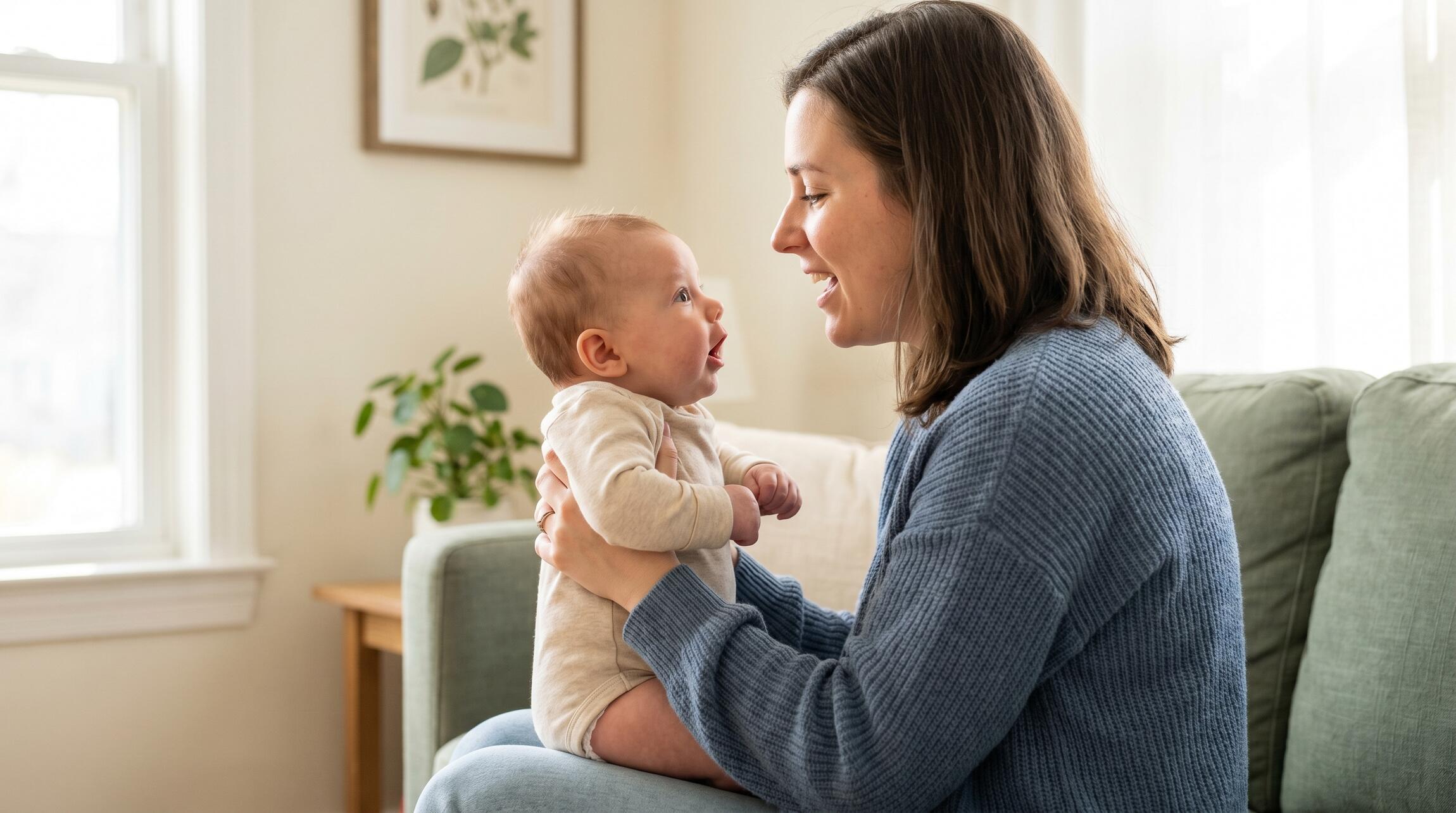
Cooing is one of the earliest sounds your baby makes — and it means their communication skills are developing right on track. Most babies start cooing around 6 to 8 weeks old, making soft vowel sounds like “ooh” and “aah.” These gentle sounds are your baby’s first attempt at “talking” with you. Cooing shows that your baby’s brain, voice box, and hearing are all working together. It is a normal and exciting milestone in speech and language development.
Key Takeaways
- Cooing is a baby’s first vocal milestone beyond crying, typically starting around 6 to 8 weeks of age
- Cooing sounds are soft, vowel-like noises such as “ooh,” “aah,” and “eee”
- Cooing is different from babbling: babbling comes later (around 4 to 6 months) and includes consonant sounds like “ba” and “da”
- You can encourage cooing by talking, singing, and responding to your baby’s sounds
- Talk to your pediatrician if your baby is not making any sounds other than crying by 2 months, or is not cooing by 4 months
What Is Cooing? Understanding Cooing Meaning
Cooing is the soft, musical sounds a baby makes using mainly vowel sounds. You might hear your baby say things like “ooh,” “aah,” “eee,” or “oh.” These sounds come from the back of the throat and are one of the first signs your baby is learning to use their voice for more than just crying.
The word “cooing” comes from the gentle sound a pigeon makes — and that is a pretty good way to describe it! Baby cooing (also called infant cooing) is smooth, quiet, and melodic. It usually happens when your baby is happy, comfortable, or looking at your face.
Cooing is an important part of early language development. Even though these sounds are not words, they show that your baby is:
- Learning to control their breathing and voice
- Practicing the mouth and throat movements needed for speech
- Starting to understand that sounds can be used to communicate
- Responding to the world around them
When Do Babies Start Cooing?
Most babies begin cooing between 6 and 8 weeks of age. However, every baby develops at their own pace. Some babies start as early as 4 to 6 weeks, while others may not coo until around 3 months old. All of these timelines are considered normal.
Here is a general guide to what you can expect:
- 1 to 2 months: Your baby starts making soft vowel sounds like “ooh” and “aah.” They may coo when they see your face or hear your voice.
- 2 to 3 months: Cooing becomes more frequent. Your baby may start “talking” back when you speak to them, taking turns in a simple back-and-forth conversation.
- 3 to 4 months: Your baby’s sounds become more varied. You may hear squeals and growls. Chuckles may appear around this age (full laughter typically develops closer to 6 months).
- 4 to 6 months: Your baby begins to transition from cooing to early babbling. You may hear “raspberries” (blowing air through the lips) and laughter. You will start hearing consonant sounds mixed in, like “ba,” “ga,” and “da.”
If your baby was born premature, use their corrected age (adjusted for how early they were born) when tracking milestones. A baby born 6 weeks early, for example, may start cooing 6 weeks later than a full-term baby.
What Does Cooing Sound Like?
Cooing sounds are soft, musical vowel noises like “ooh,” “aah,” and “eee” — often made in response to your voice. Common cooing sounds include:
- “Ooh” and “aah” — the most typical cooing sounds
- “Eee” and “oh” — slightly varied vowel sounds
- Gentle humming or sighing noises
- Squeals and coos that change in pitch
Cooing is different from crying. While crying signals a need (hunger, discomfort, or tiredness), cooing usually means your baby is content and engaged. Many babies coo the most during face-to-face time with a parent or caregiver.
Why Do Babies Coo?
Babies coo to practice vocal skills, connect with caregivers, and begin building the brain pathways needed for speech.
Cooing is not just cute — it serves several important purposes in your baby’s development:
Building communication skills. Cooing is your baby’s way of practicing for speech. Each time they make a sound and you respond, they learn that communication is a two-way street. Researchers call this “serve and return” — your baby “serves” a sound, and you “return” it with a smile, words, or sounds of your own.
Brain development. The back-and-forth of cooing conversations helps build neural connections in your baby’s brain. These early interactions shape how your baby’s language and social skills develop over time.
Social bonding. When your baby coos and sees you respond with joy, it strengthens the bond between you. Babies are more likely to coo during face-to-face interaction because cooing is a social behavior at its core.
Emotional expression. Cooing allows your baby to express comfort and happiness before they have words. It is one of their earliest ways to show you they feel safe and content.
Cooing vs. Babbling: What Is the Difference?
Cooing uses vowel sounds and starts around 6 to 8 weeks; babbling adds consonants and begins around 4 to 6 months.
Many parents wonder about the difference between cooing and babbling. While they are both important steps in speech development, they are quite different:
Cooing:
- Starts around 6 to 8 weeks old
- Uses mainly vowel sounds: “ooh,” “aah,” “eee”
- Sounds are smooth and musical
- Involves simple voice and breathing control
Babbling:
- Starts around 4 to 6 months old
- Uses consonant-vowel combinations: “ba-ba,” “da-da,” “ma-ma”
- Sounds are more rhythmic and repetitive
- Requires more complex tongue, lip, and jaw movements
Think of it this way: cooing is like a baby warming up their voice, while babbling is when they start experimenting with the building blocks of real words. Both stages are completely normal and necessary parts of learning to talk.
Between cooing and babbling, you may also hear your baby making transitional sounds like squeals, growls, and raspberries. These are all signs that your baby’s vocal skills are progressing.
How to Encourage Baby Cooing
The good news is that encouraging your baby to coo is simple — and enjoyable for both of you! Here are some ways to support your baby’s vocal development:
Talk to your baby often. Narrate your day: describe what you are doing during diaper changes, feeding, and walks. Even though your baby does not understand the words yet, they are absorbing the rhythm and patterns of language.
Use parentese. Parentese is the naturally higher-pitched, slower, and more melodic way adults tend to speak to babies. This is not the same as “baby talk” with made-up words. Parentese uses real words with exaggerated tone, and research shows it helps babies learn language faster.
Practice serve and return. When your baby coos, respond! Smile, make eye contact, and talk back. Wait for your baby to “reply,” then respond again. This back-and-forth teaches your baby how conversations work.
Read aloud. Reading to your baby — even as a newborn — exposes them to a rich variety of sounds and speech patterns. Board books with simple, rhythmic text are a great choice.
Sing songs and lullabies. Singing engages different parts of your baby’s brain and holds their attention. The repetitive patterns in songs also help your baby recognize language sounds.
Make face-to-face time a priority. Babies coo most when they can see your face. Get close, make eye contact, and let your baby watch your mouth as you talk and smile.
Watch for signs of overstimulation. If your baby turns away, fusses, or becomes quiet during interaction, they may need a break. Giving your baby quiet time to rest and process is just as important as active engagement.
When to Talk to Your Pediatrician
Every baby develops at their own pace, and there is a wide range of what is considered normal. A quiet baby is not necessarily a delayed baby — temperament plays a role too.
However, it is a good idea to talk to your pediatrician if you notice any of these signs:
- Your baby is not making any sounds other than crying by 2 months, or is not cooing (making “ooh” and “aah” sounds) by 4 months
- Your baby does not seem to respond to sounds or your voice
- Your baby does not make eye contact or smile socially by 2 to 3 months
- Your baby was cooing but has stopped and is not making other new sounds
- You have concerns about your baby’s hearing
Hearing is closely linked to vocal development. Babies need to hear sounds in order to learn to make them. If your baby had their newborn hearing screening and it came back normal, that is reassuring. But hearing problems can develop over time, so stay alert to any changes.
The most important thing to remember is that early intervention works. If there is a concern, getting help early leads to the best outcomes. Your pediatrician can evaluate your baby’s development and connect you with speech and hearing specialists if needed.
Wondering whether your baby’s sounds are on track? A Blueberry pediatrician can take a look.
Start a visitHow Blueberry Pediatrics Can Help
Every parent’s journey is different, and it is natural to have questions about your baby’s development. Whether your baby is cooing up a storm or you are still waiting for those first sweet sounds, your pediatrician is your best resource.
With Blueberry Pediatrics, you get unlimited access to board-certified pediatricians who can evaluate your baby’s milestones, answer your questions, and connect you with specialists if needed — all from the comfort of your home. No waiting rooms, no appointment delays. Just expert care when you need it.
Have questions about your baby’s development? Talk to a pediatrician from home, day or night.
Start a visitFrequently Asked Questions About Cooing
Is cooing a milestone?
Yes! Cooing is one of the earliest speech and language milestones. The CDC includes “makes sounds other than crying” as a 2-month milestone. By 4 months, babies should be making cooing sounds like “ooh” and “aah.”
Why does my baby coo so much?
Frequent cooing is a great sign! It means your baby is happy, engaged, and practicing their communication skills. Babies who get lots of face-to-face interaction tend to coo more.
Can babies coo at 1 month?
Some babies may start making very early cooing sounds as young as 4 to 6 weeks. However, most babies begin cooing closer to 6 to 8 weeks. Every baby is different, and small variations in timing are completely normal.
Is my baby cooing or babbling?
If your baby is under 4 months and making soft vowel sounds like “ooh” and “aah,” they are cooing. If they are over 4 to 6 months and producing consonant-vowel combinations like “ba-ba” or “da-da,” they have moved into the babbling stage.
Why did my baby stop cooing?
Babies sometimes go through quiet phases as they work on other skills, like reaching or rolling. If the quiet phase is brief and your baby is still socially engaged (smiling, making eye contact), it is usually nothing to worry about. If the silence lasts more than a few weeks or is paired with other changes, talk to your pediatrician.
Do deaf babies coo?
Some deaf babies do produce early cooing sounds, especially during face-to-face interaction. However, their vocalizations tend to differ from hearing babies over time, and babbling is often delayed. This is why newborn hearing screenings and follow-up hearing tests are so important.

.svg)





.svg)
.svg)

