


Baby Led Weaning: A Pediatrician's Guide to Starting Solids Safely


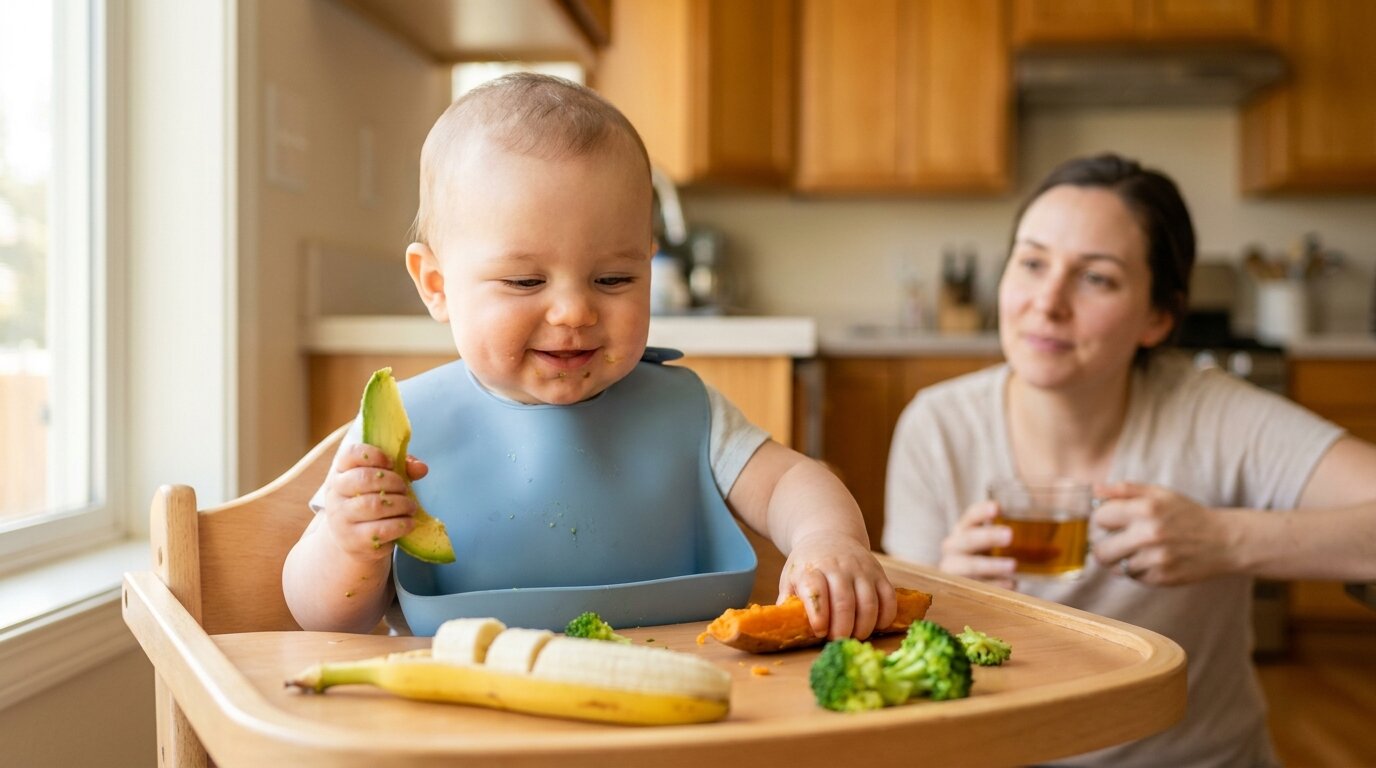
Baby led weaning (BLW) is a way to start solids. Your baby self-feeds soft finger foods instead of being spoon-fed purees. Most babies are ready around 6 months. They can sit up, hold their head steady, and show real interest in food. This guide covers readiness, safety, first foods, allergens, and step-by-step setup. Every claim is sourced to the American Academy of Pediatrics (AAP) or the Centers for Disease Control and Prevention (CDC).
Have a feeding question or a gagging moment that worried you? Message your Blueberry pediatrician any time of day.
Start a visitKey Takeaways
- Start solids around 6 months, only after your baby meets the readiness signs.
- Gagging is normal and protective. Choking is silent and is an emergency.
- Lead with a variety of iron-rich first foods, not just rice cereal.
- Introduce common allergens such as peanut and egg early, not later, in age-safe forms.
- Always feed your baby upright, buckled in a high chair, with you watching.
What Is Baby Led Weaning?
Baby led weaning is a way to start solids. Your baby picks up and feeds themselves appropriately prepared finger foods. The caregiver does not spoon-feed pureed food. The baby chooses what to grab, what to mouth, and how much to swallow at their own pace.
The AAP frames baby led weaning and spoon-fed purees as complementary, not competing. Families can mix the two without giving up the developmental benefits. A few days of spoon-fed yogurt or oatmeal will not undo your baby's ability to learn to eat on their own. For the broader first-year nutrition picture, see our Pediatrician's Guide to Baby Nutrition.
Many parents pick baby led weaning because it follows the baby's cues. It also builds chewing skills early and lets the baby join family meals. Both methods can give a baby the nutrition they need in the first year.
When to Start Baby Led Weaning
The AAP and CDC both recommend starting solids around 6 months, and not before 4 months. Most babies are ready at this age, but readiness is about skills, not just the calendar. Premature babies, or babies with trouble sitting or swallowing soft food, should wait and talk to a pediatrician first. For babies born preterm, readiness is judged by adjusted age (chronological age minus weeks premature), not the calendar.
Baby led weaning often starts a little later than spoon-feeding. Your baby needs to sit up on their own and grab food before they can self-feed safely. A 4-month-old may be ready for thin purees but not yet ready for finger foods.
Signs Your Baby Is Ready for Solids
The AAP and CDC list the same core readiness signs:
- Holds their head up steady and strong.
- Sits up with little or no support.
- Has roughly doubled their birth weight and is at least about 13 pounds.
- Opens their mouth when food is offered.
- Swallows food instead of pushing it back out with the tongue.
- Brings toys, hands, and other objects to the mouth.
- Watches you eat and reaches for your food.
For baby led weaning, independent sitting matters most. A baby who needs to be propped up is not yet ready for self-feeding, even when other signs are present.
Baby Led Weaning vs Purees: How They Compare
Baby led weaning and spoon-fed purees both lead to the same goal. By their first birthday, your baby can eat a wide range of family foods. The AAP supports both methods. Most families end up using a mix.
| Aspect | Baby Led Weaning | Spoon-Fed Purees |
|---|---|---|
| Method | Baby self-feeds soft finger foods. | Caregiver spoon-feeds pureed or mashed food. |
| Typical start age | Around 6 months, once baby sits independently. | Around 4 to 6 months with readiness signs. |
| Choking risk (per AAP) | Not higher than purees when hazard foods are avoided. | Standard background risk for all solids. |
| Skills built | Chewing, pincer grasp, food acceptance. | Swallowing, accepting new flavors. |
| Caregiver effort | Continuous supervision and food prep. | Active spoon-feeding throughout the meal. |
| Mess and pace | Messier; slower in the first weeks. | Less mess; faster intake early on. |
| AAP position | Acceptable; can mix with purees. | Acceptable; can mix with baby led weaning. |
Both methods can deliver enough iron, protein, and calories when planned well. Choose the path that fits your baby's skills, your kitchen, and your day. You can switch back and forth.
Not sure which path fits your baby? Ask a Blueberry pediatrician on a same-day message visit.
Start a visitIs Baby Led Weaning Safe? Gagging vs Choking
Baby led weaning is safe when you avoid choking-hazard foods, prepare food in the right shape, and supervise every bite. An AAP-published 2016 randomized trial, the BLISS trial (Fangupo et al., Pediatrics), looked at this directly. Babies on a structured baby-led approach, paired with parent education on hazard foods, did not choke more often than babies on traditional spoon-feeding. Choking can still happen with either method when hazard foods are missed.
Gagging is not choking. Gagging is a normal reflex that pushes food forward in the mouth when a baby takes in more than they can swallow. With daily practice, most babies gag and spit less over the first weeks.
Signs of gagging (uncomfortable to watch but normal):
- The baby coughs, sputters, or makes loud noise.
- The eyes water and the face turns red.
- Food comes back out the front of the mouth.
Signs of choking (medical emergency):
- The baby is silent and cannot cry or cough.
- The lips, face, or skin turn blue or dusky.
- The baby looks panicked and cannot move air.
If your baby is choking, start infant choking first aid right away and call 911. Every parent and caregiver of a baby starting solids should learn infant CPR and choking response before that first meal.
In pediatric telehealth visits, parents of 6 to 8 month olds commonly share videos of their baby gagging on a piece of soft food for reassurance. In most of these visits, the baby is fine and the parent is shaken. Learning the difference between gagging and choking ahead of time turns a scary moment into a normal one.
First Foods for Baby Led Weaning
Lead with iron. From 6 months on, your baby's iron stores from pregnancy run low, and food has to fill the gap. The CDC notes that iron supports red blood cells, brain development, and immune function. The AAP starting-solids guidance asks parents to include foods rich in iron and zinc. Good examples are baby food made with meat or iron-fortified cereals. If your baby is exclusively breastfed, ask your pediatrician about iron supplementation. The AAP recommends about 1 mg/kg/day of supplemental iron for exclusively breastfed full-term infants starting at 4 months, continuing until iron-rich solids are well established.
Rice cereal is not a required first food. The CDC recommends rotating cereal grains, including oat, barley, and multigrain, instead of only rice cereal, to reduce arsenic exposure.
Iron-rich first foods that work for baby led weaning:
- Shredded or thin-sliced soft cooked beef, chicken, or turkey.
- Well-cooked egg, served as a strip of omelet or scrambled pieces.
- Mashed beans or lentils, served on a pre-loaded spoon or as a soft patty.
- Tofu cut into finger-sized pieces, firm enough to grip.
- Iron-fortified infant cereal (oat, barley, or multigrain), thickened to stay on a pre-loaded spoon.
Pair plant iron foods (beans, lentils, tofu, fortified cereal) with vitamin-C-rich foods. Good pairings include berries, broccoli, citrus, or sweet potato. This pairing helps your baby absorb the iron.
How to Cut and Prepare First Foods Safely
The AAP gives clear preparation rules for baby led weaning:
- Cut foods into long, finger-shaped strips, not round coins or balls.
- Cook foods until soft enough to mash between your thumb and forefinger.
- Use a high chair with a buckled harness, with your baby fully upright.
- Stay within arm's reach for every bite.
A few quick examples:
- Banana: serve as a peeled spear with the bottom inch of peel left on for grip.
- Avocado: ripe wedges; partial peel left on if rinsed.
- Steamed broccoli: a long stem to grip, with a soft floret on top.
- Berries: large berries quartered or smashed.
- Meat: long, thin strips of slow-cooked meat rather than diced cubes.
How to Introduce Common Allergens
There is no benefit to waiting on common allergens past 4 to 6 months. The AAP is clear on this point. There is no evidence that delaying baby-safe forms of egg, dairy, soy, peanut, or fish prevents food allergy. Early, sustained exposure is the current AAP-endorsed approach, built on the LEAP trial and the NIAID 2017 Addendum guidelines.
The AAP's 2021 guidance no longer recommends risk-stratifying infants before introducing peanut and other common allergens. Introduce peanut and other common allergens around 6 months in all infants, alongside other solids, when your baby is developmentally ready.
Safe forms of peanut for babies (never whole peanuts or globs of peanut butter):
- Smooth peanut butter thinned with breast milk, formula, water, or pureed fruit.
- Smooth peanut butter stirred into oatmeal or yogurt.
- Commercial peanut puff snacks designed for infants.
Some physicians recommend introducing one new single-ingredient food every 3 to 5 days, but the evidence for that recommendation is low and it may delay the introduction of a variety of new foods. Start with about a half a spoonful. Watch for hives, rash, vomiting, swelling, wheezing, or any trouble breathing. Call 911 for any breathing difficulty or facial or tongue swelling. That is anaphylaxis and it is an emergency.
Foods to Avoid: Choking Hazards
Do not give the foods below to any baby or toddler under age 4. These are listed by the CDC as common causes of choking in young children.
Fruits and vegetables to avoid:
- Whole or chopped cherry and grape tomatoes.
- Whole grapes, berries, and uncooked dried fruit such as raisins.
- Whole or raw kernels of corn.
- Hard raw vegetables or fruit, such as raw carrot or raw apple.
Proteins to avoid:
- Whole or chopped nuts and seeds.
- Spoonfuls or globs of nut and seed butters.
- Hot dogs, meat sticks, and sausages.
- Large pieces of cheese and string cheese.
Grains and sweets to avoid:
- Popcorn, chips, and crackers with seeds.
- Hard candies, gummies, marshmallows, and chewing gum.
Cutting a firm round food into coins does not make it safe. Grapes, cherry tomatoes, and hot dog rounds are repeatedly listed by the AAP among the most common food-related choking causes. Quarter grapes, cherry tomatoes, and grape tomatoes lengthwise. Halved or sliced into coins is still a choking shape. Avoid hot dog rounds entirely for babies starting solids.
How to Start Baby Led Weaning Step by Step
- Confirm readiness. Your baby meets the AAP and CDC readiness signs, can sit on their own, and shows interest in food.
- Set up the environment. Buckle your baby into a high chair, upright, at the family table when you can. Remove distractions: no TV, no walking with food.
- Offer one new food at a time. Start with single-ingredient soft finger foods. Iron-rich foods come first.
- Pace it. Consider only introducing one food at a time so you can spot any potential reactions.
- Expect mess. Your baby will squeeze, drop, smash, and mouth food. Most calories still come from breast milk or formula in the early weeks.
- Stay present and calm. Watch every bite. If your baby gags, hold still and let the reflex work. If your baby chokes, act fast.
- Keep breast milk or formula. The CDC does not recommend cow's milk or fortified dairy alternatives as a main drink before 12 months.
- Give it time. Many babies eat very little solid food in the first weeks. That is normal and is not a feeding failure.
When to Talk to Your Pediatrician
Call your pediatrician for any of these:
- Your baby is approaching 7 months and shows no readiness signs.
- Your baby refuses solids for several weeks after a steady, calm trial.
- Your baby has ongoing vomiting, diarrhea, or constipation after starting solids.
- You see hives, rash, swelling, or vomiting after a new food.
- You are worried about weight gain or growth.
- Your baby was born preterm or has any developmental concerns. Talk before starting baby led weaning.
- There is a family history of significant food allergies, or your baby has severe eczema.
Call 911 or get emergency care right away for any of these:
- Any sign of choking: silent baby, no cry or cough, color change, distress.
- Any trouble breathing after a meal.
- Any sign of anaphylaxis: swelling of the face, lips, or tongue; wheezing; loss of consciousness.
Blueberry pediatricians are on call for feeding questions, gagging videos, and the small worries that pile up in those first weeks of solids.
Start a visitFrequently Asked Questions
When can my baby start baby led weaning?
Most babies are ready around 6 months, when they can sit up on their own, hold their head steady, and show interest in food. Do not start before 4 months. Premature babies may need to wait longer; ask your pediatrician first.
Is baby led weaning safe?
Yes, when you avoid the CDC's choking-hazard foods, cook food to a soft, finger-friendly shape, and supervise every meal. An AAP-published 2016 randomized trial (the BLISS trial) found that babies on a structured baby-led approach, paired with parent education on hazard foods, did not choke more often than babies on spoon-fed purees.
What is the difference between gagging and choking?
Gagging is loud and protective. Your baby coughs, sputters, and clears the food. Choking is silent. Your baby cannot cry, cough, or move air, and may turn blue. Start infant choking first aid and call 911 for any choking event.
What are the best first foods for baby led weaning?
Iron-rich foods first: shredded meat, well-cooked egg, mashed beans or lentils, tofu strips, and iron-fortified cereal on a pre-loaded spoon. Pair plant iron with vitamin-C foods such as berries or broccoli to help absorption.
When should I introduce peanut and egg?
Around 6 months, in baby-safe forms, alongside other solid foods. Smooth peanut butter thinned with breast milk or stirred into oatmeal works for most babies; never whole peanuts.
Do I have to start with rice cereal?
No. The CDC recommends rotating cereal grains, including oat, barley, and multigrain, rather than only rice cereal, to lower arsenic exposure. Iron-rich whole foods are an even better default first food.
This article is for general education and is not a substitute for medical advice. For questions about your child's feeding, growth, or allergies, talk with your pediatrician.
Sources
- AAP. "Baby-Led Weaning: Is It Safe?" HealthyChildren.org.
- AAP. "Starting Solid Foods." HealthyChildren.org.
- AAP. "Bite-Sized Milestones: Signs of Solid Food Readiness." HealthyChildren.org.
- AAP. "Peanut Allergies: What You Should Know About the Latest Research." HealthyChildren.org.
- CDC. "When, What, and How to Introduce Solid Foods."
- CDC. "Choking Hazards."
- CDC. "Iron." Infant & Toddler Nutrition.
- Fangupo LJ et al. "A Baby-Led Approach to Eating Solids and Risk of Choking." Pediatrics (AAP), 2016.



.svg)




.svg)
.svg)

