


At-Home Workouts for Overweight Teens (No Gym, No Equipment)


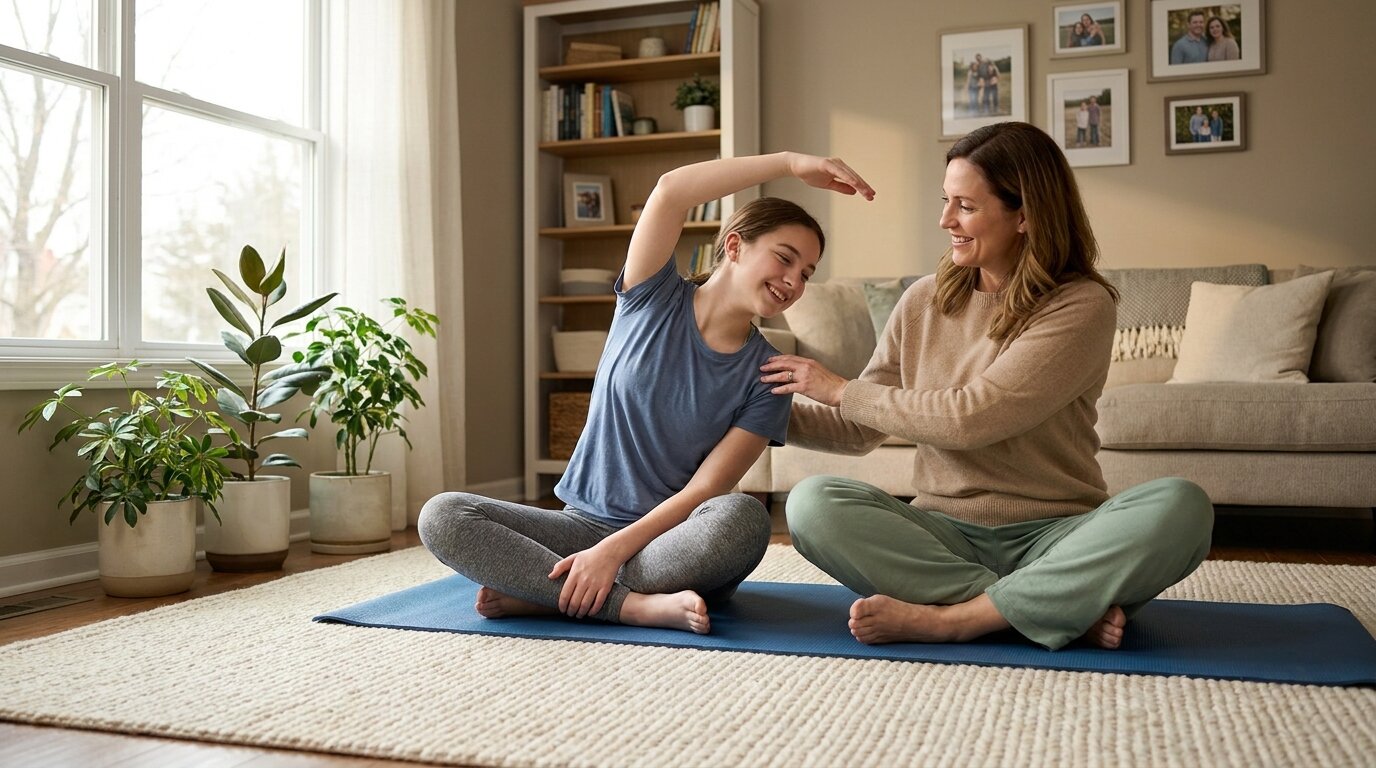
The best workouts for a teen who is just starting out are short and low-impact: 10 to 15 minutes of simple, no-equipment movement at home, like walking, gentle stretching, and simple bodyweight moves once your pediatrician gives the okay, building up gradually from there. What matters most is not intensity. It is finding movement your teen enjoys enough to come back to.
Blueberry Balance pairs board-certified clinicians with dietitian and lifestyle support to help teens build habits that stick.
Talk with a Balance specialistKey Takeaways
- Start small. About 10 to 15 minutes of easy movement, a few days a week, then build up slowly. The American Academy of Pediatrics (AAP) suggests exactly this starting dose, 10 to 15 minutes, for a teen who is out of shape.
- Strength before cardio. For teens carrying extra weight, the AAP recommends starting with simple strength moves rather than a running or cardio program. Most workout advice starts with cardio.
- No gym needed. Squats, wall push-ups, glute bridges, marching, and dancing all work in a bedroom with no equipment.
- Move for how it feels, not how it looks. Think steadier energy, a better mood, and feeling stronger, not changing how a body looks or weighs.
- Most healthy teens do not need a doctor's okay just to start walking or moving more. Check first if there is chest pain, dizziness, unusual shortness of breath, joint pain, a limp, or a known health condition, or before starting strength training.
- New hip, thigh, groin, or knee pain, or a new limp, is not "just sore." Stop and call your pediatrician.
Before Your Teen Starts: A Quick Safety Check
Most healthy teens can start moving more on their own. But a few symptoms are worth a call to your pediatrician first.
Most teens do not need a doctor's sign-off to start walking more or dance in their room. The federal Physical Activity Guidelines for Americans note that people without a diagnosed chronic condition and without symptoms generally do not need to check in with a clinician before becoming more active.
Check with your pediatrician before your teen starts if any of these apply:
- Chest pain or pressure, dizziness, or unusual shortness of breath, during activity or at rest
- Joint pain, or pain in the hip, thigh, groin, or knee
- A limp, or a change in how they walk
- A known heart, lung, or orthopedic condition, or high blood pressure, or a seizure disorder
- They are planning to start strength training. The AAP recommends checking with your child's doctor before starting any strength training exercises.
And check in after they start if new symptoms show up. The guidelines are specific about this: people who develop new symptoms as they increase their activity should talk to a clinician.
One quick rule before strength training
The AAP recommends checking with your child's doctor before your teen starts any strength training exercises. While you wait for a visit, light aerobic movement like walking, dancing, and marching in place is a good place to start.
How Much Activity Do Teens Actually Need?
The commonly cited target is 60 minutes a day, but it does not have to happen all at once or on day one.
Federal guidelines recommend that kids and teens ages 6 through 17 get 60 minutes or more of moderate-to-vigorous physical activity a day (U.S. Department of Health and Human Services, Physical Activity Guidelines for Americans, 2nd edition, 2018). The American Academy of Pediatrics gives the same 60-minute target for kids 6 and older.
If that number feels far away, here is the part that helps: it does not have to be done all at once. As the AAP puts it, "the 60 minutes does not need to be done all at once." Short blocks through the day add up, so a 20-minute walk, 10 minutes of dancing, and some active chores all count toward the same goal. If your teen is not active right now, start from where they are and build from there.
No-Equipment Workouts for Teens You Can Do at Home
Start with simple bodyweight strength, then add gentle low-impact cardio. No gym, no equipment, and nothing that has to happen in front of anyone.
Here is where Blueberry does something different from the usual workout list. For teens who carry extra weight, the AAP says to start with simple strength moves, not a running or cardio plan. Strength moves are easier on the body. They do not leave a teen out of breath in front of anyone, and they build quick wins. That makes them a kinder place to start than a run.
One myth worth clearing up first, because parents ask about it constantly.
"Well-designed resistance training programs have not been shown to have a negative effect on physeal (growth plate) health, linear growth, and cardiovascular health in youth."
American Academy of Pediatrics, Resistance Training for Children and Adolescents, 2020
In plain language: bodyweight strength moves do not stunt a growing teen.
The AAP reports that most resistance-training injuries happen on home gym equipment, with unsafe technique and no supervision (Stricker et al., AAP, 2020). Sticking to your teen's own body weight removes the equipment, and doing the moves alongside them covers the rest, so make it something the whole family can join, not something one kid gets sent off to do alone.
Here is a starter menu your teen can mix and match:
| Type | Moves to try | How to start |
|---|---|---|
| Warm-up (about 5 minutes) | Arm circles, gentle marching, easy hip and shoulder rolls | Loosen up before anything else |
| Bodyweight strength (start here) | Bodyweight squats, wall push-ups, glute bridges, sit-to-stands from a chair | 1 to 2 sets of 8 to 12 slow reps, easy effort |
| Low-impact movement (no jumping) | Marching in place, step-ups on a bottom stair, dancing without jumping | A few minutes, at a pace they can talk through |
| Gentle cardio | A walk, stair steps, dancing to a few favorite songs | Build up minute by minute |
| Cool-down | Slow stretches, a few deep breaths | Ease down for a few minutes |
A few coaching notes as your teen works through the menu: keep good form over speed, and make any move easier if it needs to be, like wall push-ups instead of floor push-ups or a smaller squat. If your teen feels self-conscious or is very out of shape, skip the jumping at first, and keep the pace to one where they can still talk.
A Gentle 4-Week Starter Plan (Build Up, Don't Burn Out)
This is one simple way to build up, not a rule. Adjust it to your teen, and let how they feel set the pace.
The plan below is Blueberry's own suggested starting point, not an official schedule from any health group. The idea is to build a habit, not to hit a target. If a week feels like too much, repeat it. If it feels easy, add a little.
| Week | One simple way to build up |
|---|---|
| Week 1 | 10 to 15 minutes of easy movement, 2 to 3 days. Mostly a walk plus a few bodyweight moves. |
| Week 2 | Same length, add one more day, or add a couple of minutes on the days you already move. |
| Week 3 | Stretch a few sessions to 15 to 20 minutes. Add a second short set of strength moves if it feels good. |
| Week 4 | Aim for movement most days, in whatever mix your teen enjoys. Length matters less than showing up. |
If your teen misses a few days, that is normal. The goal is coming back to it, not a perfect streak.
Making It Stick: Movement a Self-Conscious Teen Will Actually Do
Enjoyment is the whole strategy. A teen keeps doing what feels good and private, and quits what feels like punishment or a spotlight.
For a teen who feels self-conscious, the setting matters as much as the moves. At-home, no-audience options let them move without feeling watched. Let them pick what they like, whether that is dancing, a walk with headphones in, or a few strength moves in their room. Choice is not a small thing here. It is what turns "exercise" into something they own.
Enjoyment is not just a nice idea, either. It is written into the guidance. The federal guidelines say inactive teens should build up activity "in ways that they enjoy," and the AAP describes doing "physical activity for enjoyment and self-care reasons" as part of what healthy movement looks like. So picking something fun is following the advice, not cutting corners.
Keep it away from weight and appearance. The AAP has been clear that shame and pressure do not motivate healthy change. In fact, weight-focused teasing is linked to less activity, not more. So the parent's job is to offer and to join in, not to police or supervise. Movement is something the whole family can do together, and framing it that way keeps any one kid from feeling singled out.
When to Talk to Your Pediatrician
Some aches are normal, and a few are not. Knowing the difference is the most useful thing on this page.
When an ache needs a call, not a "wait and see"
Some muscle soreness a day or two after new activity is normal and fades. Pain in a joint is different, especially pain in the hip, thigh, groin, or knee, or a new limp. In teens, hip and knee pain can occasionally signal a growth-plate problem that is more common during the growth years and at higher body weights, and it is one where getting looked at early really matters. If your teen has new hip, thigh, groin, or knee pain, or you notice them limping or walking differently, stop the activity and call your pediatrician. Do not wait for the next scheduled visit.
It is also worth a call if your teen wants to get moving but feels stuck, discouraged, or unsure where to start. That is exactly the kind of thing a pediatric team can help with.
Blueberry Balance is our adolescent metabolic-health program: board-certified clinicians, dietitians, and lifestyle support to help teens build lasting habits. We're here when your family's ready to start.
Talk with a Balance specialistFrequently Asked Questions
How much exercise does a teenager actually need?
Federal guidelines recommend 60 minutes or more of moderate-to-vigorous activity a day for ages 6 through 17 (HHS, Physical Activity Guidelines for Americans, 2nd edition, 2018), and the AAP gives the same 60-minute target for kids 6 and older. It does not have to happen all at once, and short blocks through the day add up.
Is it safe for an overweight teen to start working out, and what should we check first?
For most healthy teens, easing into walking and gentle bodyweight moves is safe. Check with your pediatrician first if your teen has chest pain, dizziness, unusual shortness of breath, joint pain, a limp, or a known heart, lung, or orthopedic condition, high blood pressure, a seizure disorder, or another ongoing health condition, or before starting any strength training. Then start slow and build up gradually.
What exercises can a teen do with no equipment?
Plenty. Marching in place, step-ups on a stair, walking, dancing, and gentle stretching need nothing at all, and simple bodyweight moves like squats, wall push-ups, glute bridges, and sit-to-stands are the next step once your pediatrician gives the okay. Starting with simple strength moves, rather than cardio, is what the AAP recommends for teens carrying extra weight.
Does strength training stunt a teen's growth?
No. According to the AAP, well-designed resistance training has not been shown to harm growth-plate health or linear growth in young people. Bodyweight strength work is a safe place for a teen to start, once their pediatrician has given the okay.
How do I help a self-conscious teen start without making it about weight?
Keep it private, let them choose the activity, and talk about how movement feels rather than how it looks. Offer to join in instead of supervising, and make it a whole-family habit. Focusing on energy, mood, and strength (not weight) is both kinder and the approach pediatricians recommend.
The Bottom Line
Start small, start with strength, and let your teen pick movement they actually enjoy. Ten to fifteen minutes a few days a week is a real beginning, not a warm-up to the "real" plan. Watch for the few red flags that need a call, keep the tone shame-free, and move as a family. That is how a habit takes hold.
Related reading: Healthy Snacks for Teens and How to Talk to Your Teen About Weight.
Sources
- U.S. Department of Health and Human Services. Physical Activity Guidelines for Americans, 2nd edition. 2018. (60-minute activity target for ages 6 through 17; graded "start low and go slow" onset; symptom list for when to consult a clinician.)
- American Academy of Pediatrics (HealthyChildren.org). Energy Out: Daily Physical Activity Recommendations. 2014. (60 minutes for children 6 and older; "does not need to be done all at once"; check with your child's doctor before strength training.)
- American Academy of Pediatrics (HealthyChildren.org). Overcoming Obstacles to Physical Activity. 2011. (Start slow with 10 to 15 minutes; walking is a great start.)
- Stricker PR, Faigenbaum AD, McCambridge TM; AAP Council on Sports Medicine and Fitness. Resistance Training for Children and Adolescents. Pediatrics. 2020;145(6):e20201011. (Start with basic resistance exercises for youth with overweight or obesity; growth-plate myth; warm-up and cool-down.)
- Hampl SE, Hassink SG, Skinner AC, et al. Clinical Practice Guideline for the Evaluation and Treatment of Children and Adolescents With Obesity. Pediatrics. 2023;151(2):e2022060640. (Gradual, stepped increase in activity; hip and knee pain and limp as findings that need evaluation.)
- Pont SJ, Puhl R, Cook SR, Slusser W; AAP Section on Obesity and The Obesity Society. Stigma Experienced by Children and Adolescents With Obesity. Pediatrics. 2017;140(6):e20173034. (Shame and stigma reduce, rather than increase, physical activity.)



.svg)





.svg)
.svg)

